Art Deco Jewelry: Geometry, Color, and Identification Clues
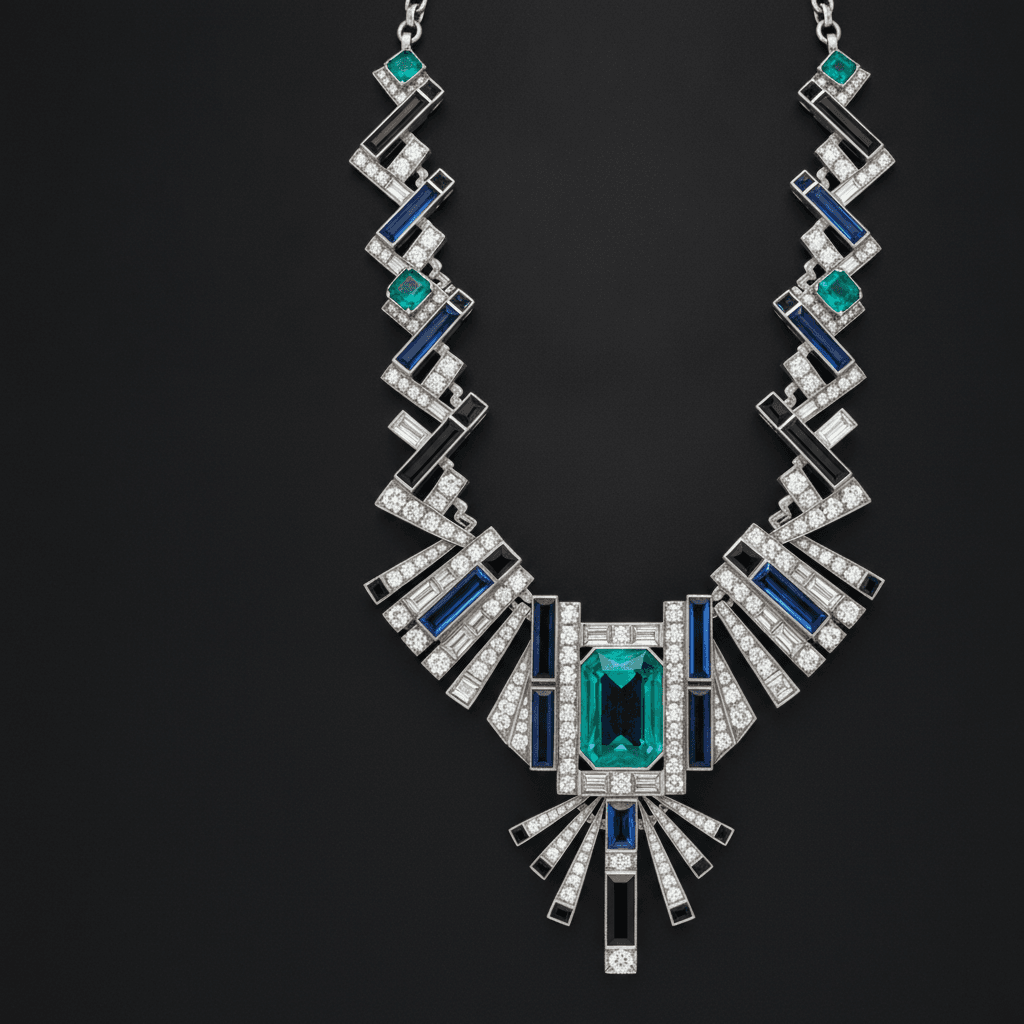
Art Deco is broader than one date range
Art Deco developed internationally during the 1920s and 1930s, with roots before the First World War and influence that continued later. The 1925 Exposition Internationale des Arts Décoratifs et Industriels Modernes in Paris gave the movement a defining public platform, although the label Art Deco was applied retrospectively.
For jewelry, date ranges such as 1920–1935 are useful orientation, not a universal border. Different makers and markets adopted modern geometry at different times, and later revivals reproduced the look.
Visual language
Art Deco jewelry often uses disciplined geometry and strong visual organization. Features can include:
- symmetry, repeated modules, and stepped or rectilinear outlines;
- circles, arcs, triangles, chevrons, fans, plaques, and calibrated borders;
- contrast between colorless diamonds and onyx, coral, jade, turquoise, emerald, ruby, sapphire, or other materials;
- dense gemstone arrangements with carefully shaped components;
- platinum or white-metal settings, especially in high jewelry;
- yellow gold becoming more visible in the 1930s;
- long linear earrings, bracelets, clips, sautoirs, rings, vanity objects, and convertible pieces;
- influences drawn from machines, architecture, global decorative traditions, and archaeology.
The V&A notes sharp geometric patterns, international inspiration, and dense concentrations of gemstones in Art Deco jewelry. It also records a return of gold from about 1933, cautioning against the myth that authentic Art Deco must always be platinum and white.
Cultural sources require precise language
Designers drew from Egyptian, East and South Asian, African, Indigenous American, and other visual traditions through the unequal collecting, trade, exhibition, and colonial networks of the period. Avoid reducing those sources to an “exotic” decoration checklist. Identify the documented design reference when evidence exists and acknowledge that a geometric motif alone may have multiple origins.
Cooper Hewitt's Jazz Age exhibition emphasizes the transatlantic exchange, urbanity, experimentation, and diverse influences that shaped 1920s design. Use museum research rather than repeating a simplified King Tut explanation for every motif.
Distinguish Art Deco from neighboring styles
Edwardian and Garland-style jewelry often uses white metal, diamonds, bows, wreaths, and open lace-like structures. Art Deco tends to regularize or abstract forms into stronger geometry and bolder contrast. Art Nouveau generally favors sinuous asymmetry, plants, insects, figures, enamel, and expressive materials.
Retro jewelry of the 1940s inherits some Deco structure but usually appears heavier, warmer in gold color, more curved, and more volumetric. These are tendencies, and transition pieces can combine features.
Photograph evidence that can establish more than style
Capture the front, reverse, profile, clasp, pin, hinge, joints, setting edges, and all marks. Record dimensions and weight. A straight-on image shows geometry; side and reverse images show fabrication, wear, replacement parts, and whether a plaque was converted from another use.
Research maker, assay, patent, and inventory marks in reliable archives. Preserve fitted cases, receipts, family photographs, repair records, and old appraisals. A case or famous signature must be connected to the object; neither is self-authenticating.
Stone cuts can support a date range but not prove it. Old-cut diamonds were reset, and modern lapidaries can reproduce historic shapes. Calibrated colored components may also be glass, synthetic material, treated gems, or replacements. Use gemological testing when identity affects the conclusion.
Period versus revival
Art Deco remained influential in later decades and is widely reproduced today. White gold, laser-cut settings, modern safety findings, casting evidence, or current maker marks may point to a later interpretation, but repairs can mix old and new components. Evaluate the piece as a construction history rather than rejecting it because one fitting is later.
A responsible description might say “Art Deco-style geometric bracelet, likely later revival” when the visual vocabulary is clear but period evidence is absent.
Care and condition
Geometric settings can contain many small stones and narrow joints. Check for loose calibré-cut elements, worn channels, cracked onyx or enamel, and old repairs. Do not use ultrasonic or steam cleaning until every stone, treatment, and repair is known. Coral, jade, turquoise, pearls, glued elements, and fracture-filled stones require special caution.
Store the piece supported and separated from harder jewelry. Avoid aggressive polishing that rounds crisp edges, removes plating, or erases marks.
Do not infer value from the style name
Period, maker, metal, gemstone identity and quality, condition, completeness, provenance, alteration, and market all shape value. An unsigned period piece and a signed modern revival require different research, but either can be well made. Define whether the question is insurance, auction, dealer retail, or likely resale before using comparables.
The useful conclusion
Art Deco identification is strongest when geometry and color are paired with construction, marks, provenance, and testing. Use the style to organize evidence, not to turn a visual resemblance into a guaranteed 1920s date.
Want more jewelry knowledge?
Download our app for quizzes, care guides, and AI identification