What Is Statement Jewelry? A Visual Identification Guide
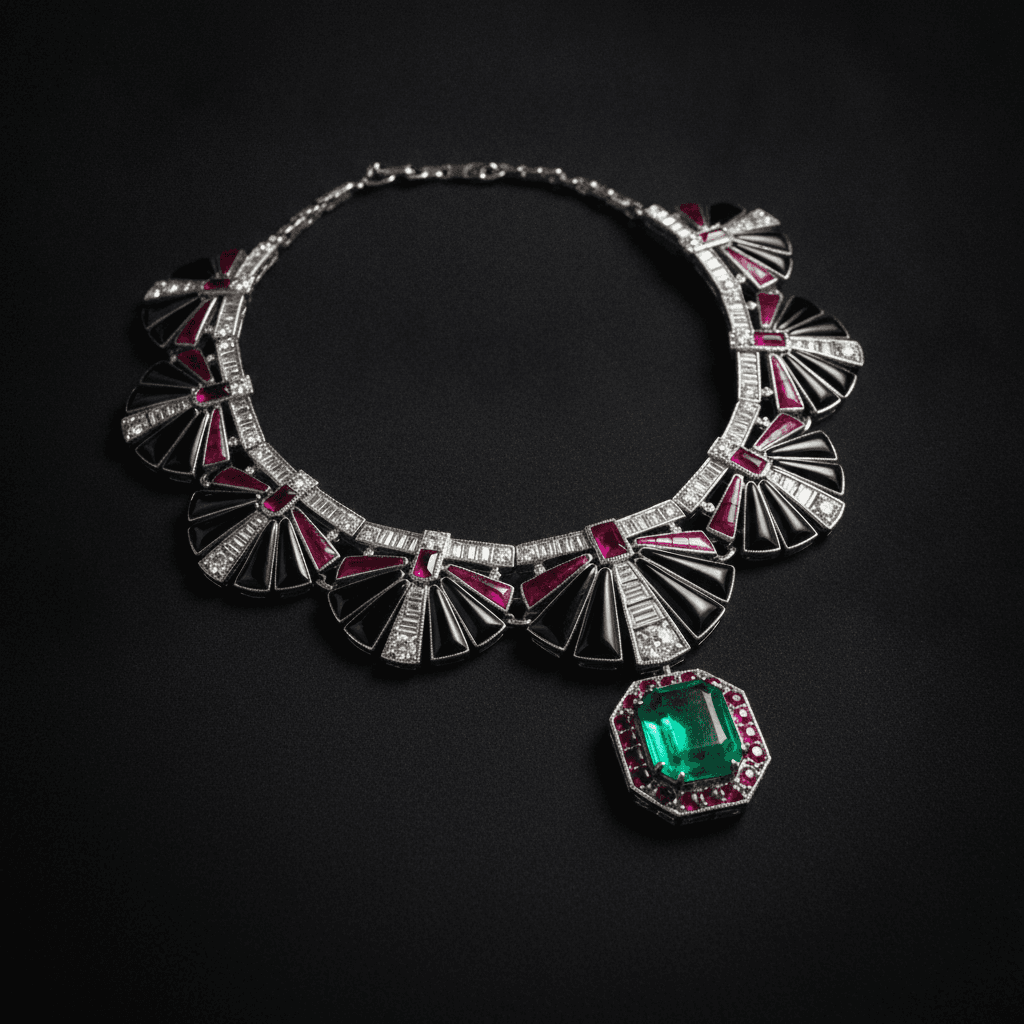
It is a role, not a measurement
Statement jewelry is an informal style label for a piece intended to hold strong visual or conceptual attention when worn. There is no official minimum necklace width, pendant diameter, ring span, or color requirement. A large jeweled collar may be a statement piece, but so can a stark geometric brooch, an unusual material, or a small object placed in a visually dominant way.
The Metropolitan Museum of Art describes jewelry through its interaction with the body: it can extend, amplify, accentuate, conceal, or transform the wearer. That framework is more useful than a rigid size chart. The Museum of Arts and Design likewise presents modern and contemporary jewelry across a range from minimal to theatrical, using both everyday and opulent materials.
Five visual signals
1. Scale relative to the body
Judge scale in context. A broad cuff occupies much of the wrist; a collar changes the line of the neck and shoulders; long earrings move beside the face. Photographing the item worn or beside a ruler helps communicate scale, but height-based fashion rules are subjective and should not be presented as fact.
2. Contrast
Contrast may come from color, light, surface, silhouette, or material. Blackened metal around a polished element can be as emphatic as bright gemstones. A single white form against dark clothing can attract more attention than a multicolored piece. Contrast is descriptive, not evidence of age, quality, or maker.
3. Placement and silhouette
Some jewelry makes a statement by framing a face, crossing the chest, spanning several fingers, or projecting away from the body. Look at the outline from a distance before concentrating on individual stones. Brooch placement can transform an otherwise modest object into the focal point of a garment.
4. Movement and sound
Fringe, articulated links, suspended elements, and flexible structures respond to motion. Movement can be central to the design, as can controlled sound. Check whether moving parts are intentional and secure; a loose stone or broken jump ring is not design movement.
5. Concept and material surprise
Contemporary art jewelry may use paper, plastic, textile, found objects, industrial metal, or unconventional combinations. Cooper Hewitt's Jewelry of Ideas traces how makers pushed form, material, and concept beyond conventional preciousness. A statement can come from an idea about identity, value, environment, memory, or the body—not only from expense.
Statement jewelry across time
Bold personal adornment appears across cultures and historical periods, but applying today's label to every large historical ornament can flatten its original meaning. The Met's Jewelry: The Body Transformed shows jewelry serving social, political, spiritual, and status roles over thousands of years. A court jewel, ceremonial collar, protective ornament, and contemporary gallery necklace may all command attention while belonging to very different contexts.
Describe the known culture, date, function, and provenance first. Use statement jewelry as a modern visual category, not a substitute for historical identification.
How to inspect an unidentified statement piece
Begin with photographs of the complete silhouette, front, back, side, attachment, closure, and all marks. Record dimensions and weight rather than guessing. Note whether the piece is rigid, flexible, modular, convertible, or designed for a particular garment position.
Then separate observations:
- base construction: cast, fabricated, woven, assembled, molded, carved, or printed;
- surface: polished, hammered, enamelled, coated, painted, oxidized, or textured;
- materials that are confirmed versus merely visual possibilities;
- repeated modules, asymmetry, negative space, and focal elements;
- repairs, replacements, missing parts, and wear where the object touched the body;
- maker marks, signatures, labels, and documented ownership.
An unusual material does not prove a piece is contemporary, and substantial weight does not prove precious metal. Test consequential claims through qualified analysis.
Distinguish neighboring labels
Statement describes visual emphasis. Costume jewelry describes a broad category commonly made with non-precious or imitation materials, though definitions vary. Art jewelry emphasizes artistic practice and ideas. Studio jewelry often points to maker-led production. Fine jewelry generally refers to precious materials and established trade practices. One object can fit more than one label.
Minimalist and statement are not true opposites. A large, unornamented silver plane can be both minimalist in form and statement-making in scale. Conversely, a small ring can make a conceptual statement without being visually large.
Avoid unsupported value conclusions
Boldness does not establish rarity, age, authenticity, or price. A mass-produced resin necklace can have a dramatic silhouette; a historically important studio brooch may look restrained. Value research needs maker attribution, material testing, condition, provenance, comparables, and a defined market.
The useful takeaway
Call a piece statement jewelry when its relationship to the body, scale, contrast, movement, or concept makes it a focal point. Then add the evidence that actually identifies it: dimensions, materials, construction, marks, condition, and context. That turns a subjective style label into a useful research description.
Want more jewelry knowledge?
Download our app for quizzes, care guides, and AI identification