Art Nouveau Jewelry: Nature, Enamel, and Identification Clues
Dates are approximate and regional
The Metropolitan Museum of Art describes Art Nouveau developing in western Europe and the United States from the 1880s until the First World War. The Victoria and Albert Museum frames Art Nouveau jewelry and the Garland style around 1895–1910, with the movement reaching a peak near the 1900 Paris exhibition.
Those ranges reflect different subjects and regions. Art Nouveau also had local names and related movements. Use a date range and place when possible rather than treating 1890–1910 as a rigid universal boundary.
The line is often the first clue
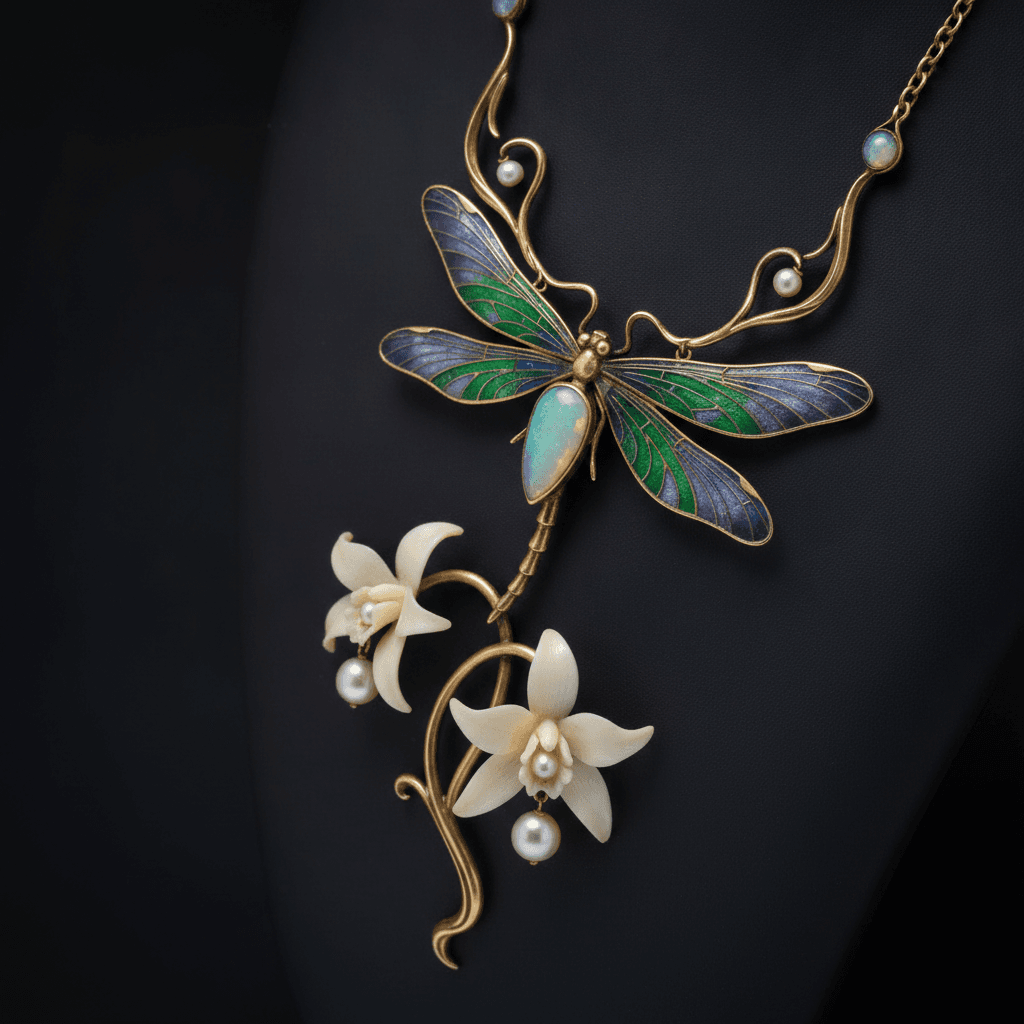
Art Nouveau is known for sinuous, asymmetric movement often described as a whiplash curve. Designers drew from stems, waves, wings, hair, vines, and other organic forms. The Met connects this visual language to close observation of nature and to botanical and scientific illustration.
In jewelry, recurring subjects include flowers, orchids, insects, dragonflies, butterflies, snakes, birds, and female figures transformed through natural or fantastical elements. Not every floral piece is Art Nouveau. Compare how the line moves, whether the composition is symmetrical, and whether the motif is naturalistic, abstracted, or part of a later revival.
Materials served artistic effects
The V&A notes that leading Art Nouveau jewelers placed greater emphasis on glass, horn, enamel, and other subtle material effects than conventional preciousness alone. Opals, moonstones, baroque pearls, and colored stones could support translucency and changing light. Plique-à-jour enamel created a stained-glass-like effect without a full metal backing.
This did not necessarily make the jewelry inexpensive or widely accessible. Innovative artist-made pieces could demand exceptional labor and elite patronage. Material cost and artistic importance are separate questions.
The same material palette continued in later revival work. Horn, glass, enamel, opal, and pearl-like elements therefore support a description only when considered with construction, marks, date evidence, and provenance; material appearance alone cannot establish a period or maker.
Art Nouveau versus Garland and Edwardian jewelry
At the same turn-of-the-century moment, Garland-style and Edwardian high jewelry favored symmetry, platinum, diamonds, pearls, bows, wreaths, and lace-like openwork. Art Nouveau generally appears more asymmetrical, sensual, narrative, and material-driven.
The same broad floral subject can occur in both. An orchid rendered in translucent enamel and horn differs from a symmetrical diamond garland, even if the date overlaps. Some makers worked across styles, so attribution needs object-specific evidence.
Art Nouveau versus Arts and Crafts
Arts and Crafts jewelers also valued handcraft, nature, and nontraditional hierarchies of materials. Their work can appear more visibly constructed, geometric, or medievalizing, while French and Belgian Art Nouveau often emphasizes flowing line and technically elaborate enamel. These are not absolute divisions, and national movements developed their own forms.
Examine an unidentified piece
Photograph the full silhouette, reverse, profile, attachment, hinge, clasp, joins, enamel edges, stone backs, and all signatures or marks. Record dimensions and weight. Diffuse and transmitted light may help document translucent enamel, but do not expose the piece to heat or intense light.
Look for:
- fabrication that supports flowing three-dimensional line;
- enamel technique and condition;
- how horn, glass, metal, and stones are joined;
- a maker's signature, assay mark, or workshop number;
- original case, invoice, exhibition record, or period photograph;
- repairs, replaced fittings, and missing components.
René Lalique, Georges Fouquet, Philippe Wolfers, and other celebrated makers are widely copied. A dragonfly, female profile, or plique-à-jour effect does not establish authorship. Compare signatures, construction, dimensions, provenance, and documented museum examples.
Period work versus revival
Art Nouveau was revived and imitated throughout the twentieth century and remains a popular design source. Modern enamel, cast construction, current hallmarks, and contemporary findings may support a later date, but original pieces can also be repaired with later fittings. Describe the object as Art Nouveau-style when the design is clear but period evidence is not.
Do not use artificial aging, surface dirt, or a worn box as proof. Evaluate components separately and keep uncertainty visible.
Care requires restraint
Enamel can crack or detach; horn, glass, opal, pearls, adhesives, and old solder all respond differently to water, heat, chemicals, and vibration. Avoid ultrasonic and steam cleaning. Do not polish across enamel or remove a patina that may be intentional. Store the piece fully supported, away from hard jewelry and direct light.
An objects conservator may be more appropriate than routine commercial cleaning for a significant piece. Photograph condition before any treatment.
A responsible conclusion
Art Nouveau identification rests on more than nature motifs. Sinuous line, material effects, enamel technique, construction, maker evidence, date, place, and provenance should converge. A precise description such as “Art Nouveau-style enamel pendant, possibly early twentieth century” is stronger than a famous-maker attribution based only on appearance.
Want more jewelry knowledge?
Download our app for quizzes, care guides, and AI identification