Edwardian Jewelry: Platinum, Garland Motifs, and Identification
Dates depend on whether you mean reign or jewelry period
King Edward VII reigned from 1901 to 1910. Jewelry histories often use a broader Edwardian range around 1900–1915, carrying the style through the years immediately before the First World War. GIA's research describes the age as distinctive for platinum, pearls, diamonds, and new manufacturing techniques, while its consumer history uses 1900–1915 as a design-period frame.
State which meaning you intend. A piece dated 1912 may be Edwardian in jewelry style even though Edward VII had died, while a jewel made during his reign may belong visually to Art Nouveau, Arts and Crafts, or another current.
The characteristic visual language
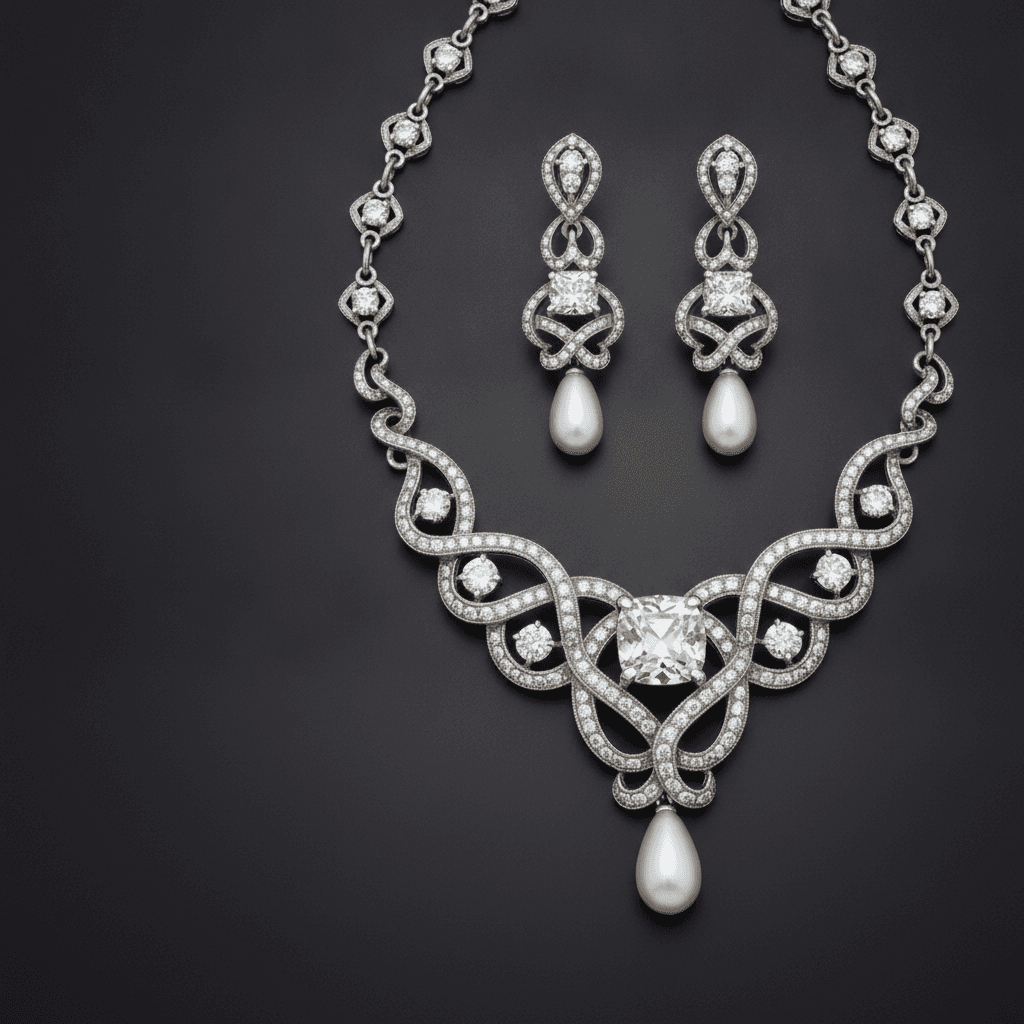
Edwardian high jewelry often emphasized a light, white, symmetrical appearance. Frequently discussed features include:
- platinum frameworks with fine open spaces;
- diamonds and natural pearls, sometimes with colored-gem accents;
- bows, ribbons, swags, wreaths, flowers, laurel, and tassels;
- lace-like openwork and beaded milgrain edges;
- knife-edge bars and narrow structural elements;
- articulated drops and convertible tiara, necklace, brooch, or pendant components;
- balanced compositions suited to formal dress.
These are common tendencies, not a formula. Gold, silver, colored stones, and less formal objects also existed. Natural pearls were important, but a pearl's presence or appearance cannot establish that it is natural or Edwardian.
Edwardian, Belle Époque, and Garland style
The labels overlap geographically and socially. Edwardian describes a British royal and cultural frame. Belle Époque is commonly used for continental, particularly French, turn-of-the-century culture. Garland style names the court-inspired ribbons, bows, and floral ornament seen in elite diamond jewelry across markets.
GIA's historical overview places Edwardian or Garland-style jewelry around 1900–1915 and Art Nouveau around 1890–1914, showing that two very different aesthetics coexisted. Art Nouveau favored sinuous, asymmetrical forms, enamel, horn, glass, opal, insects, plants, and figures. Edwardian Garland work generally appears more symmetrical, white, and historically courtly.
Platinum is important but not self-proving
Technological developments made extensive platinum construction practical around this period. Its strength allowed narrow supports and openwork that appeared delicate while holding many stones. Do not use an exact melting-point story or a white-metal appearance as authentication.
White metal may be platinum, silver, white gold, another alloy, or plating. Some objects combine platinum settings with gold components. Metal testing and correctly interpreted marks are needed when composition matters. Repairs may introduce newer metal or solder.
Inspect the reverse and fittings
Photograph the complete front, reverse, profile, clasp, pin, hinge, safety mechanism, joins, settings, and marks. The reverse can reveal construction, alteration, and whether a brooch fitting, chain, or conversion was added later. Record dimensions and weight and preserve any fitted case or documentation.
Old-cut diamonds, milgrain, and lace-like patterns are supporting clues, but all were used in later revival jewelry. Stones are frequently reset. A modern reproduction may use genuine old-cut stones, and an original Edwardian setting may contain later replacements.
Pearl origin needs laboratory evidence
Surface appearance and texture cannot establish whether a pearl is natural, cultured, or an imitation. GIA documents a laboratory process that combines gemological observation with instruments including real-time X-radiography, UV-Vis reflectance spectroscopy, and X-ray fluorescence. Avoid abrasive folk tests; record pearl-like components as unconfirmed, and seek an appropriate laboratory report when origin materially affects attribution or value.
Condition and care
Fine openwork, knife-edge elements, pearl attachments, old solder, and articulated drops may be vulnerable after a century of wear and repair. Inspect for movement, thinning, cracks, bent pins, missing milgrain, and replacement components. Do not place the piece in an ultrasonic or steam cleaner until the gems, treatments, construction, and repairs are understood.
Store it supported in a separate padded container. Avoid tension on convertible fittings and dangling sections. Preserve patina and faint marks; aggressive polishing can remove evidence and alter an intended finish.
Authentication and valuation
No photograph can prove Edwardian date, platinum content, diamond origin, or natural pearls. A strong attribution combines hallmark research, metal and gem testing, construction analysis, provenance, maker archives, and comparison with cataloged museum objects.
Do not infer price from the period label. Maker, material, stone quality, pearl origin, condition, rarity, provenance, alteration, and market all affect value. Separate gemological reporting from financial appraisal.
A precise description
A cautious catalog entry might read: “White-metal openwork pendant with symmetrical bow and garland motifs, colorless stones, beaded edges, and an articulated pearl drop. The design is Edwardian or Belle Époque in style; date, metal, stones, pearl origin, and later alterations require testing and provenance.”
That conclusion is useful because it states both the visual evidence and the limits. Edwardian identification should narrow the research path, not replace it.
Want more jewelry knowledge?
Download our app for quizzes, care guides, and AI identification