Georgian Jewelry: Dates, Design, and Identification Clues
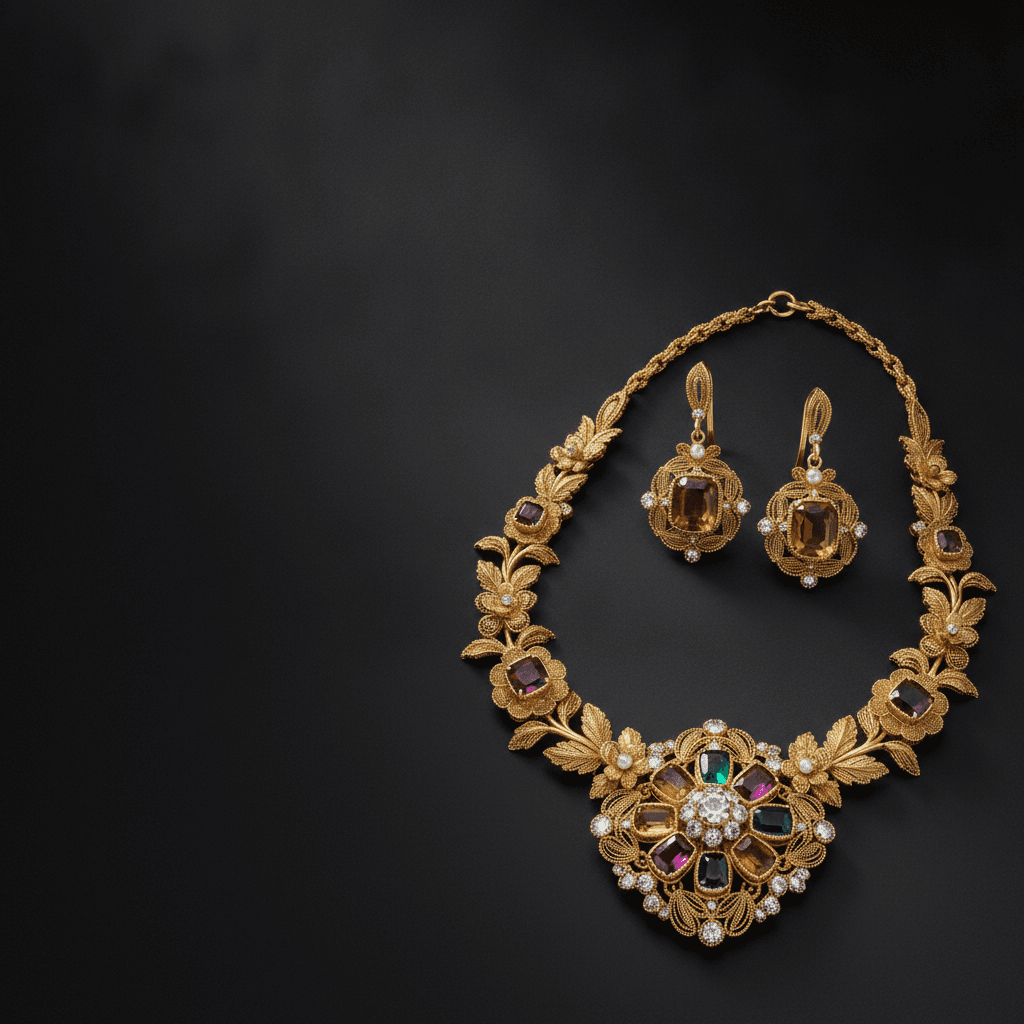
Georgian is a broad historical label
In British history, the reigns of George I through George IV run from 1714 to 1830. Jewelry dealers sometimes extend “Georgian” through the reign of William IV to 1837, while museums may organize objects by century, ruler, country, or design movement instead. State the convention you are using rather than treating 1837 as a universally agreed endpoint.
More than a century of jewelry cannot be reduced to one set of features. Court diamond ornaments of the eighteenth century, sentimental mourning rings, neoclassical cameos, and early nineteenth-century naturalistic jewels can all fall within or overlap the label.
What museum evidence shows
The Victoria and Albert Museum explains that brilliant-cut diamonds became dominant in eighteenth-century court jewelry and were frequently mounted in silver to emphasize their white appearance. It also notes that relatively little of that diamond jewelry survives because valuable gems and metal were often sold or reset as fashions changed.
For the early nineteenth century, the V&A describes classical and archaeological revival styles followed by growing interest in recognizable flowers and fruit. Its documented 1816 peridot jewelry associated with Princess Charlotte shows how colored stones and royal provenance can form part of Georgian-period study.
Royal Collection Trust provides another dated comparison: the Diamond Diadem ordered from Rundell, Bridge & Rundell in 1820 for George IV's 1821 coronation. Its openwork silver frame is lined with gold and set with diamonds and pearls. It is one exceptional court object, not a template for ordinary Georgian jewelry, but it demonstrates the value of documentation that joins date, maker, materials, purpose, and later history. Together, these examples caution against claiming that Georgian jewelry is always dark, foil-backed, high-karat gold, or made in one technique.
Useful visual and construction clues
Depending on date, place, and function, clues may include:
- silver-set diamonds or mixed silver-and-gold construction;
- closed-back collet settings, sometimes with foil behind a stone;
- hand-fabricated components and visible variation;
- rose-cut, old mine-style, table-cut, or other historic stone forms;
- repoussé, engraving, chased surfaces, granulation-like detail, or wirework;
- bows, flowers, ribbons, urns, portraits, eyes, hair, inscriptions, cameos, and classical motifs;
- memorial, sentimental, devotional, court, or dress functions.
None is conclusive alone. Closed backs persisted later, historic cuts are reused, and Georgian Revival jewelry copies old techniques. “Entirely handmade” is also too absolute: workshops divided labor, components could be standardized, and the evidence needed to characterize manufacture varies by object.
Photograph the evidence before cleaning
Capture the front, reverse, profile, setting edges, hinge, clasp, joins, stone backs, inscriptions, and every mark. Use a ruler and neutral light. Do not open a sealed setting, scrape a surface, or polish faint marks to make them easier to read.
Closed-back and foil-backed jewelry can be damaged by immersion. Moisture may enter behind stones, stain foil, disturb adhesives, or remain trapped. Until construction is known, use only gentle dry handling and obtain advice from a conservator or jeweler experienced with antique pieces.
Marks may be incomplete or absent
Hallmarking rules varied by jurisdiction, object, and date. A missing hallmark does not prove great age, and a plausible mark does not establish authenticity. Components may have been replaced, imported, repaired, or combined from different periods.
Research each mark in the correct official assay system. Compare construction with dated museum objects, not just marketplace listings. Provenance such as wills, inventories, portraits, fitted cases, receipts, and family records can be especially valuable when marks do not settle the question.
Georgian versus Victorian and later revival
Victorian jewelry begins with Victoria's reign in 1837, but design does not change overnight at a royal accession. Early Victorian pieces can share naturalistic, sentimental, and classical features with late Georgian work. Later nineteenth-century archaeological revivals can resemble earlier neoclassical jewelry, and twentieth-century Georgian Revival pieces may reproduce closed settings and old-cut stones.
Date the object from converging evidence: component construction, fastening technology, stone cutting, metal testing, marks, and provenance. If the findings conflict, consider a later alteration or composite object rather than forcing one label.
Avoid rarity and value shortcuts
Survival rates such as “less than one percent” require evidence and should not be repeated without a defined dataset. Price ranges are equally misleading across a category that includes paste buckles, mourning rings, royal jewels, repaired fragments, and modern reproductions.
Age alone does not determine value. Maker, material, rarity, condition, historical significance, provenance, alterations, and market demand all matter. A valuation also needs a purpose: insurance replacement, auction, dealer retail, and likely resale are not interchangeable.
A responsible description
When certainty is limited, write: “Gold- and silver-colored closed-back cluster ring with an old-style cut and hand-fabricated appearance. The construction is consistent with Georgian or later Georgian Revival work, but date, metal, stone identity, and alterations remain unconfirmed.”
That phrasing records useful evidence without converting visual resemblance into authentication. Georgian identification is strongest when a long historical period is treated as a research question rather than a checklist.
Want more jewelry knowledge?
Download our app for quizzes, care guides, and AI identification