Can You Tell If a Diamond Is Real at Home? What Common Tests Miss
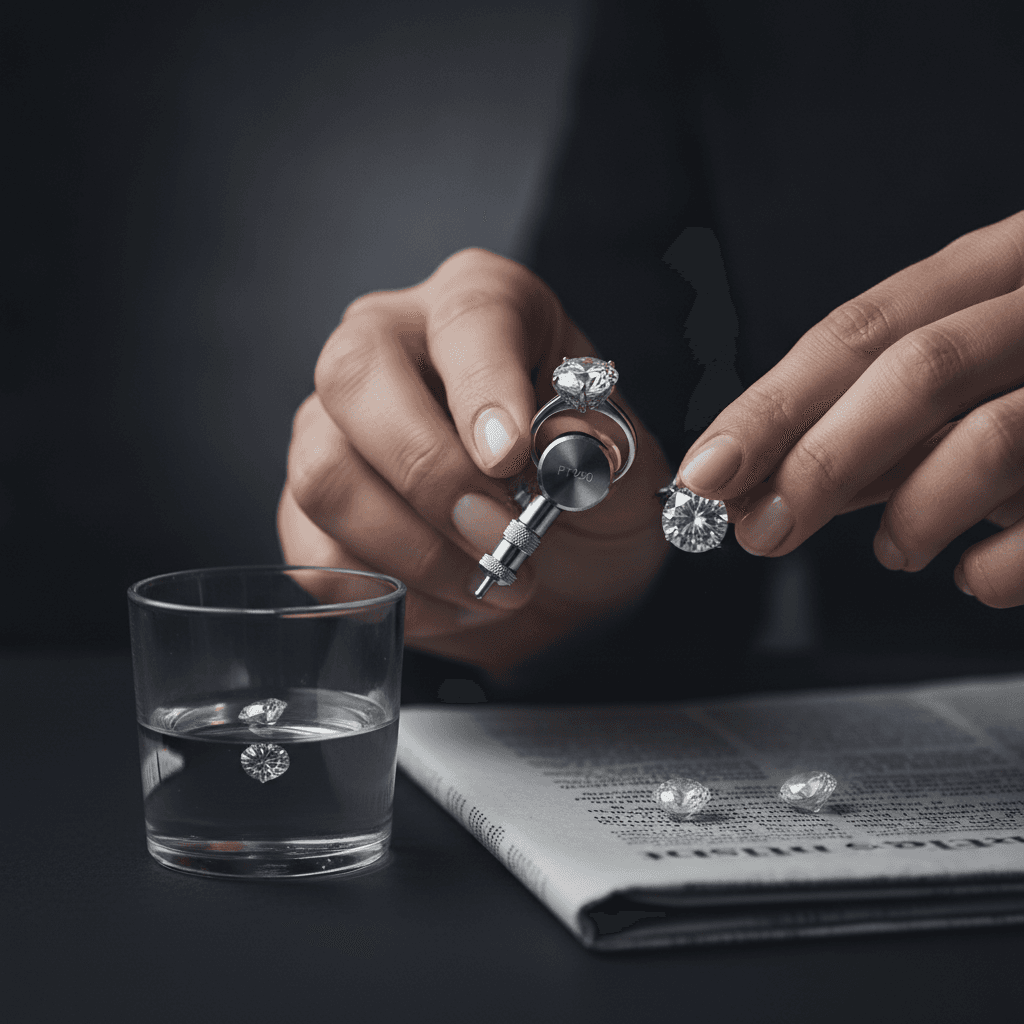
Short answer: not conclusively
There is no reliable at-home test that can prove a stone is a natural diamond. The Gemological Institute of America warns that popular fog and newspaper tests are inconsistent or misleading. Appearance alone also cannot separate a natural diamond from every laboratory-grown diamond, moissanite, cubic zirconia, glass, or other simulant.
A home inspection can help you document clues and spot reasons to ask more questions. It should not be used to authenticate a purchase, set a value, or accuse a seller of misrepresentation.
Why the popular tests fail
Fog is affected by more than identity
Diamond conducts heat well, but the way condensation clears also depends on surface contamination, coatings, temperature, airflow, stone size, and how the test is performed. A quick-clearing fog does not prove that a stone is diamond, and a lingering fog does not prove that it is fake.
Sinking in water is not a useful verdict
Many gemstone and glass materials sink in water. A mounted item also contains metal and trapped air, while dropping a loose stone risks loss or damage. A sink-or-float observation does not provide a controlled density measurement and cannot authenticate a diamond.
Newspaper visibility depends on cut and viewing conditions
Whether print can be seen through a stone changes with its cut, proportions, orientation, setting, lighting, and the observer. A result may look different across genuine diamonds and simulants. GIA specifically cautions against treating this as a conclusive test.
Sparkle is not a material analysis
Brilliance and colored flashes change with cut quality, lighting, cleanliness, camera processing, and viewing angle. Moissanite, cubic zirconia, and other stones can all look convincing in ordinary photographs. Visual character can guide questions, but it is not proof of composition or origin.
The setting identifies the setting—not necessarily the stone
A gold or platinum quality mark is a claim about a metal component. Stones can be replaced, settings can be altered, and marks can be incomplete or counterfeit. A valuable stone may appear in a modest setting, and a simulant may appear in precious metal. Evaluate the stone and every component separately.
Safe things you can do at home
- Photograph the stone face-up, from the side, beneath the setting, and beside every mark without using filters or digital zoom.
- Save receipts, grading reports, repair records, boxes, and provenance notes. Verify any report number directly with the issuing laboratory rather than relying on a screenshot.
- Inspect for chips, loose prongs, glue, abrasion, doubled facet edges, or obvious bubbles as observations to discuss—not as a final identity test.
- Ask the seller for the stone's identity, whether it is natural or laboratory-grown, any treatments, the return policy, and the evidence supporting those claims.
- Keep the item secure and avoid experiments that could alter it before professional examination.
Tests to avoid
Do not scratch glass, scrape the stone, expose it to flame or sudden temperature changes, use acids or household chemicals, or force it out of a setting. These methods can damage the stone, a treatment, the mounting, or another surface without producing a trustworthy identification.
What a professional can establish
A qualified independent gemologist or gemological laboratory can combine magnification with appropriate thermal, electrical, optical, and spectroscopic instruments. The exact process depends on whether the question is diamond versus simulant, natural versus laboratory-grown origin, treatment, quality grading, or value. A basic handheld tester may help with some simulants, but it is not a substitute for a complete examination.
A gemological grading report documents identity and quality characteristics for an eligible stone. It is different from a financial appraisal, and neither a photograph nor this website can replace it when a consequential purchase, insurance decision, or sale depends on the answer.
The responsible takeaway
Use home observations to prepare better photographs, preserve records, and decide whether testing is warranted. Do not use fog, water, newspaper, sparkle, or setting checks as a pass/fail verdict. When the answer matters financially or emotionally, obtain independent testing and keep the uncertainty explicit until that work is complete.
Want more jewelry knowledge?
Download our app for quizzes, care guides, and AI identification