How to Test Gold and Silver Jewelry: What Each Method Can Prove
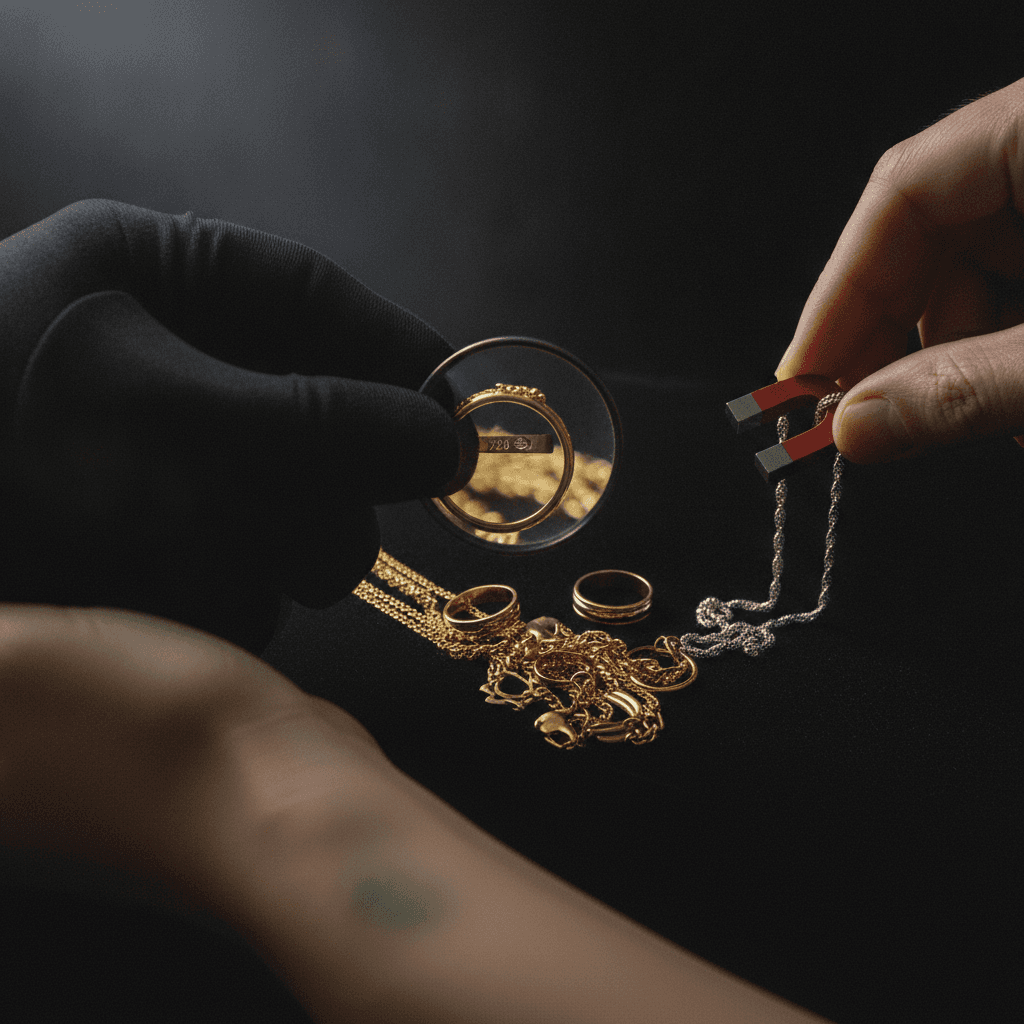
Short answer
No single home test can prove that a piece is solid gold or sterling silver. A hallmark is a useful claim to investigate, a magnet can rule out some possibilities, and wear patterns may reveal a coating. None of those observations measures the composition of the whole item. When purity affects a purchase, sale, repair, or insurance decision, use a qualified jeweler, assay office, or laboratory that can choose an appropriate testing method.
The safest approach is evidence in layers: document the item, read every mark in context, inspect separate components, and then use professional testing if the answer matters.
Start with the complete mark, not one number
A quality mark such as 14K, 585, Sterling, or 925 states a claimed metal proportion. In the United States, FTC consumer guidance also tells buyers to look for the name or registered trademark of the business standing behind a gold or silver quality mark. In the United Kingdom, a complete statutory hallmark has several components, including a sponsor mark, metal-and-fineness mark, and assay-office mark. The systems are not interchangeable.
Photograph the entire mark set before cleaning. Record where each mark appears. A clasp, pendant, chain, detachable earring back, or repaired section may have a different material from the main piece. A lone number can be copied, applied to one component, or misunderstood outside its country and construction context. It is evidence, not automatic proof.
What a magnet can and cannot tell you
Gold and silver themselves are not strongly attracted to an ordinary magnet. Strong attraction can therefore indicate that at least part of an item contains a magnetic material. That may be useful as a warning, but it does not identify the metal and it does not prove fraud. Clasps, springs, pins, internal supports, solder, and mixed-metal components can behave differently from the visible body.
No attraction is even less conclusive. Many base metals and alloys are also nonmagnetic. Passing a magnet check does not establish gold karat, silver fineness, solid construction, or the absence of plating.
Why skin, ceramic, biting, and scratch tests are poor evidence
Skin discoloration depends on alloy, coatings, sweat, cosmetics, moisture, and individual skin chemistry. It is not a purity measurement. Dragging jewelry across unglazed ceramic can scratch the item, remove surface material, or leave a streak that is easy to misread. Biting or bending can deform settings and does not distinguish many alloys. Filing through a surface may expose a core, but it permanently alters the piece and can erase useful evidence.
Do not use household chemicals, bleach, improvised acids, flame, or sudden heat. These can injure the user and damage metal, solder, plating, gemstones, treatments, enamel, adhesives, and finishes. An acid or touchstone process belongs in trained hands with ventilation, protective equipment, appropriate reference acids, and a clear reason for accepting a small test mark.
What professional methods add
Touchstone testing compares the response of a controlled metal streak with reference materials. It can be useful when performed by an experienced operator, but results depend on sampling, observation, and whether plating or mixed construction is present.
X-ray fluorescence, usually called XRF, can rapidly estimate elemental composition without cutting the item. GIA describes XRF as widely used for precious-metal analysis, but recent GIA casework also shows an important limitation: surface plating can produce a misleadingly high reading, especially when the coating and underlying alloy contain the same element. Shape, finish, calibration, solder, and the exact spot tested also matter. A responsible operator combines instrument results with microscopy, multiple test locations, construction knowledge, and other methods when necessary.
An official hallmark in a regulated assay system represents independent testing under that system. It still needs to be genuine, complete, and applicable to the component being evaluated. For an unhallmarked or suspicious item, an assay office or qualified precious-metal laboratory can advise whether a non-destructive screen is enough or whether a more definitive assay is justified.
A practical verification checklist
- Photograph the item, all marks, high-wear edges, clasps, joints, repairs, and color changes.
- Write down the seller's exact material claim and the evidence supplied with it.
- Interpret the marks using the rules of the likely country and period.
- Treat magnet response, color, weight, and wear as observations rather than verdicts.
- Ask how a proposed professional test works, which areas will be tested, and whether it can detect plating or mixed construction.
- Keep the testing report, receipt, return terms, and photographs together.
The responsible takeaway
Visual and home checks are best used to decide what to investigate next. They cannot turn an unknown item into verified gold or silver. Avoid destructive shortcuts, preserve the piece, and match the testing method to the financial and historical stakes of the question.
Want more jewelry knowledge?
Download our app for quizzes, care guides, and AI identification