GIA Lab-Grown Diamond Reports: Current Terms and Verification
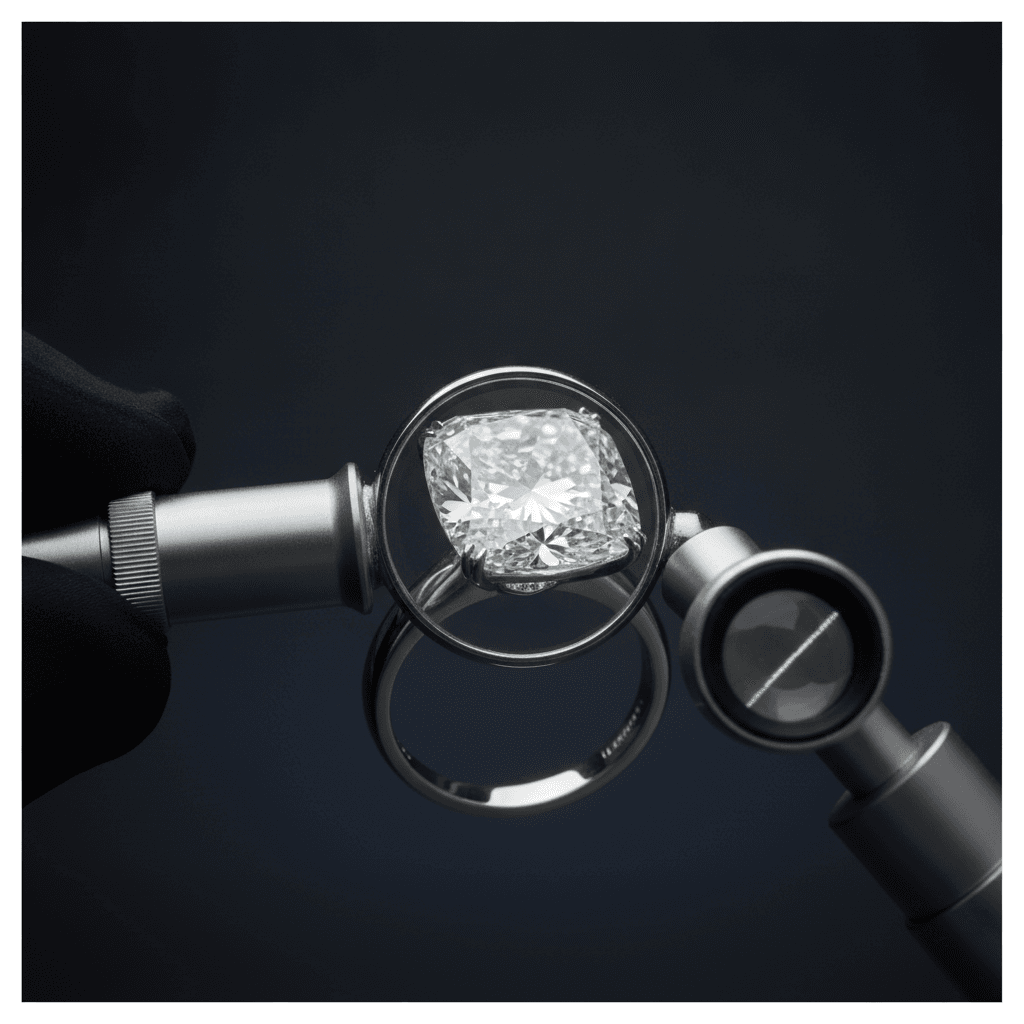
GIA’s current service for qualifying colorless-to-near-colorless laboratory-grown diamonds uses a Laboratory-Grown Diamond Quality Assessment. It classifies an eligible stone as Premium or Standard instead of applying the natural-diamond color and clarity nomenclature. That distinction matters when you compare a new assessment with an older report or a seller’s listing.
Laboratory-grown diamonds are still diamonds, not simulants. Their manufactured origin cannot be established from sparkle, a photograph, or a basic diamond tester. Use clear seller disclosure, laboratory evidence, and a physical match between the stone and its document.
What GIA’s current service provides
As of August 2026, GIA offers its Laboratory-Grown Diamond Quality Assessment for loose, colorless-to-near-colorless laboratory-grown diamonds weighing at least 0.15 carats. Stones that meet the service criteria receive an overall Premium or Standard classification based on the assessment of color, clarity, and cut-related qualities. A submitted stone that does not meet the minimum Standard criteria does not receive one of those classifications.
GIA states that an assessed stone’s girdle is laser inscribed with “Laboratory-Grown” and the quality assessment number. This is different from assuming that every lab-grown diamond in the market must have a GIA inscription. A stone may have been examined by another laboratory, may predate the current service, may fall outside its eligibility rules, or may never have been submitted.
GIA has separate reports for laboratory-grown colored diamonds. Those services can include growth type, post-growth treatment information, and a plotted clarity diagram, depending on the report. Read the exact document title before interpreting its fields.
Why an older GIA document may look different
A legitimate older report can use terminology that GIA no longer uses for new colorless-to-near-colorless lab-grown assessments. The document date, service name, and report format establish which system applied when the stone was examined. Do not reject an older report solely because it contains color and clarity information that is absent from the current Premium or Standard format.
At the same time, an old report should not be described as proof of a current GIA classification. Record what the document actually says. If a seller advertises a current Premium assessment, the report-check record and physical stone should support that precise claim.
Material identity, origin, and quality are separate questions
Laboratory-grown diamond material is produced by a manufacturing process, commonly high pressure, high temperature (HPHT) or chemical vapor deposition (CVD). Cubic zirconia and moissanite are simulants: they can resemble diamond but are different materials. “Is it diamond?” and “Was it mined?” therefore require separate answers.
Quality is another question. Origin does not tell you whether a stone has attractive cutting, visible inclusions, damage, or a particular color. A report or assessment records specified observations for the examined item; it does not guarantee beauty, price, resale demand, or suitability for a setting.
Why photographs and basic testers cannot confirm origin
GIA’s identification research describes advanced analysis of growth-related and treatment-related features. Laboratories may use magnification, fluorescence imaging, spectroscopy, and other instruments together. No single visual feature works as a universal shortcut.
A conventional thermal tester may help separate some simulants from diamond, but a laboratory-grown diamond is diamond and can respond like a natural diamond. A loupe can reveal a readable inscription or useful internal features, yet a missing inscription is not proof of natural origin and a visible inscription can be copied. Phone photographs add uncertainty from lighting, focus, reflections, dirt, and the setting.
An app scan is useful for documenting shape, setting style, visible marks, and questions to investigate. It cannot replace laboratory testing for diamond origin.
How to verify a GIA lab-grown diamond document
Use a verification sequence that connects the listing, document, and physical item:
- Read the service name and date. Determine whether the document is a current quality assessment, a colored-diamond report, or an older report format.
- Check the record with GIA. Enter the number in GIA Report Check rather than trusting a screenshot or a seller-hosted copy.
- Compare recorded facts. Match the shape, carat weight, measurements, and other listed characteristics with the stone and sale documents.
- Inspect the girdle inscription. When the service calls for one, have it read under suitable magnification and compare the full number and wording.
- Confirm the seller’s description. The listing, invoice, and return policy should consistently identify the stone as laboratory-grown.
- Resolve mismatches before the return period ends. A valid number proves that GIA issued a record; it does not prove that an unrelated stone is the one examined.
Mounted jewelry can make measurements and inscription reading difficult. For a consequential purchase, ask an independent qualified gemologist or laboratory to examine the item while return rights remain available.
Seller disclosure should appear before purchase
The U.S. Federal Trade Commission advises advertisers to disclose clearly and conspicuously that a laboratory-created diamond is not mined. The qualification should be close to the diamond claim and early in the description, not buried on a separate education page. Simulated or imitation products also need wording that does not confuse them with laboratory-grown diamond.
Ask for the origin in writing. Also ask whether post-growth treatment is known, which laboratory issued the document, whether the report number is verifiable, and which item the invoice covers. “Real diamond” does not answer origin because both mined and laboratory-grown material can be diamond.
What the evidence can establish
A matched laboratory record can support material identity, laboratory-grown origin, and the characteristics covered by that service on the examination date. It does not establish current retail value, future resale value, environmental impact, or ethical superiority. Those claims need their own evidence.
The strongest conclusion joins three records: an accurate seller disclosure, an official report-check result, and a physical match to the stone. If one part is missing, describe the uncertainty instead of filling it with a visual guess.
Want more jewelry knowledge?
Download our app for quizzes, care guides, and AI identification