Mid-Century Modern Jewelry: 1950s–1960s Identification Guide
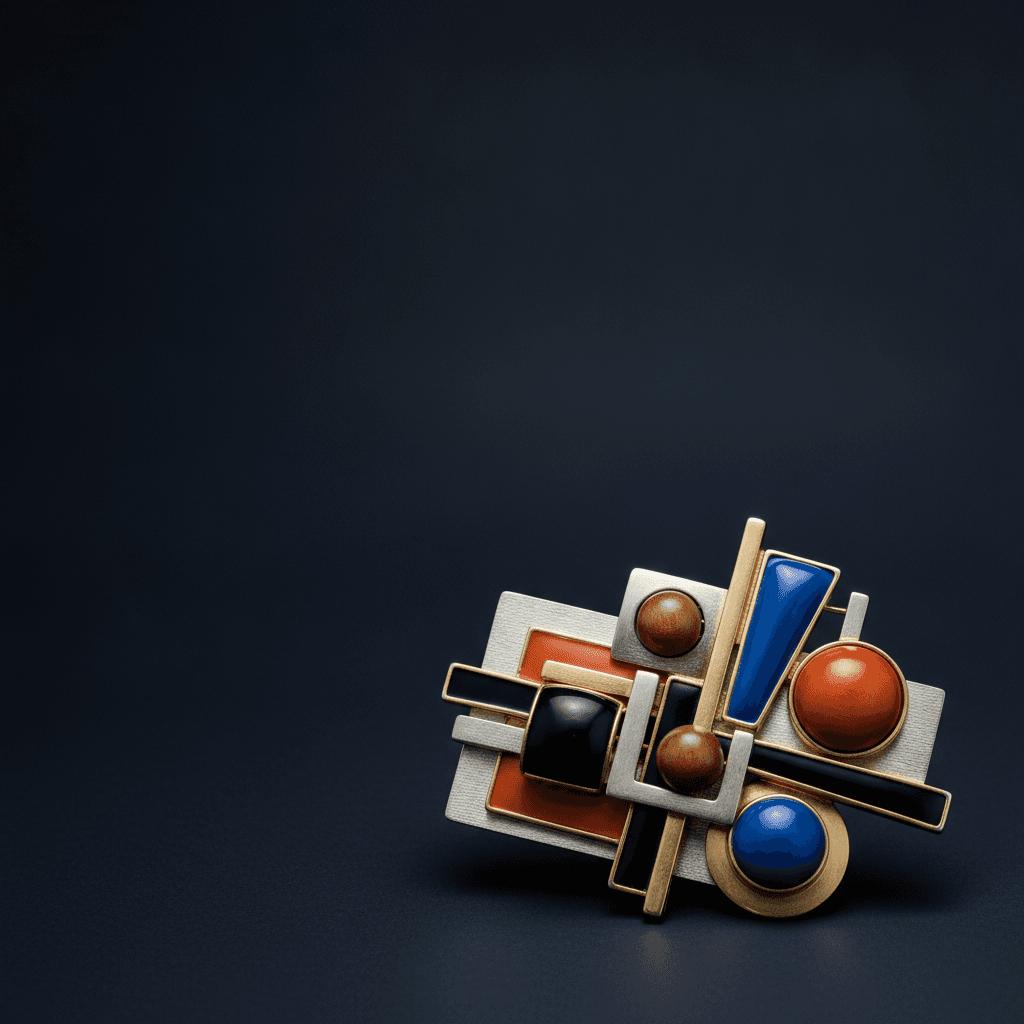
Mid-century is a family of approaches
The phrase mid-century modern is used broadly for design around the middle decades of the twentieth century. In jewelry, it should not imply one fixed combination of atomic shapes, oversized proportions, Lucite, and enamel. GIA's study of jewelry from the Second World War through the mid-1960s traces several transitions: 1940s Retro forms, colorful gem-rich work in the 1950s, and a late-1950s and 1960s revival of individual craftsmanship in which overall form could become more important than gemstones.
At the same time, American and European studio jewelers explored abstraction, sculpture, industrial metals, and the body. Fine jewelry houses, costume manufacturers, Scandinavian designers, artist-jewelers, and small workshops all contributed different visual languages.
Four useful strands
Fine jewelry after Retro
Some 1950s jewelry retained substantial gold, colored stones, and three-dimensional floral or ribbon forms while moving away from the heavier curves of the 1940s. Gemstones could be arranged into flexible clusters and textured surfaces rather than a single central stone.
Studio jewelry
Studio makers emphasized individual design and direct making. The Smithsonian American Art Museum identifies Art Smith as a pioneer of the American studio jewelry movement and records his use of brass, copper, imaginative asymmetry, and designs connected to dance and the body. That evidence explains a movement; it does not mean every abstract brass piece is by Smith.
Scandinavian and international modernism
Reduced geometry, organic line, restrained ornament, and attention to material appeared in many regional practices. Maker and country matter because similar clean forms arose in different workshops and were widely copied.
Costume and production jewelry
Manufacturers used molded plastics, glass, plated metals, rhinestones, enamel, and mechanized findings to create fashionable work at varied price points. Production does not make a piece historically uninteresting, but it changes the evidence used for attribution and value.
Visual clues worth recording
Potential mid-century features include abstract or biomorphic silhouettes, asymmetric balance, textured or hammered metal, wire construction, negative space, articulated modules, sculptural brooches, and integrated fasteners. Starbursts and other space-age motifs appear, but they are neither universal nor unique to the period.
Do not rely on color names such as turquoise or coral without testing. A bright insert may be enamel, glass, plastic, resin, ceramic, dyed material, or a gem. Likewise, gold color does not prove solid gold.
Document the back, marks, and engineering
Photograph front, reverse, side, clasp, pin mechanism, earring back, chain, joins, and every mark. Record dimensions and weight. Note whether parts are cast, forged, soldered, stamped, woven, molded, or assembled. Look for wear at attachment points and evidence that a pin, clip, chain, or ear fitting was replaced.
Research signatures and maker marks in museum records, archival catalogs, patent databases, and reliable monographs. A partial signature or familiar motif is not enough. Compare measurements, materials, and construction with documented examples.
Original boxes and cards help only when provenance connects them to the object. A branded box can be paired with unrelated jewelry.
Distinguish Retro, mid-century, and contemporary
Retro is most closely associated with the 1940s and heavy, curved gold forms that retained and softened aspects of Art Deco. Mid-century work from the 1950s and 1960s ranges from gemstone-rich fine jewelry to abstract studio practice. Contemporary jewelry, as museums often discuss it, develops further from the 1960s onward through conceptual and material experimentation.
The boundaries overlap. Date a specific object from its evidence rather than deciding that every geometric piece is Art Deco or every asymmetrical piece is mid-century.
Care follows construction
Mixed materials, plated finishes, old adhesives, plastics, enamel, patina, and tension-set components need individualized care. Some early plastics can craze, discolor, or react with storage materials. Do not soak, polish, heat, or apply solvent to an unidentified mid-century piece. Preserve oxidized and textured surfaces unless qualified evidence shows they are unwanted corrosion.
Store pieces separately and support heavy brooches, neckpieces, and projecting forms. Inspect old clips and pins before wear. A historically important studio object may be better treated by an objects conservator than polished by a general jewelry service.
Avoid the price shortcut
Mid-century value can depend on documented maker, production line, material, rarity, condition, provenance, exhibition history, and design significance. A base-metal studio work may have a market unrelated to melt value; an unsigned mass-produced piece may be valued mainly as wearable vintage design. Do not publish broad price ranges without current comparables and a defined market.
The responsible conclusion
Use “mid-century modern” as a starting style description, then identify the strand: fine, studio, Scandinavian, costume, or another documented context. The most persuasive attribution combines the front silhouette with reverse construction, marks, provenance, and museum comparison.
Want more jewelry knowledge?
Download our app for quizzes, care guides, and AI identification