How to Read Jewelry Hallmarks, Quality Marks, and Maker Marks
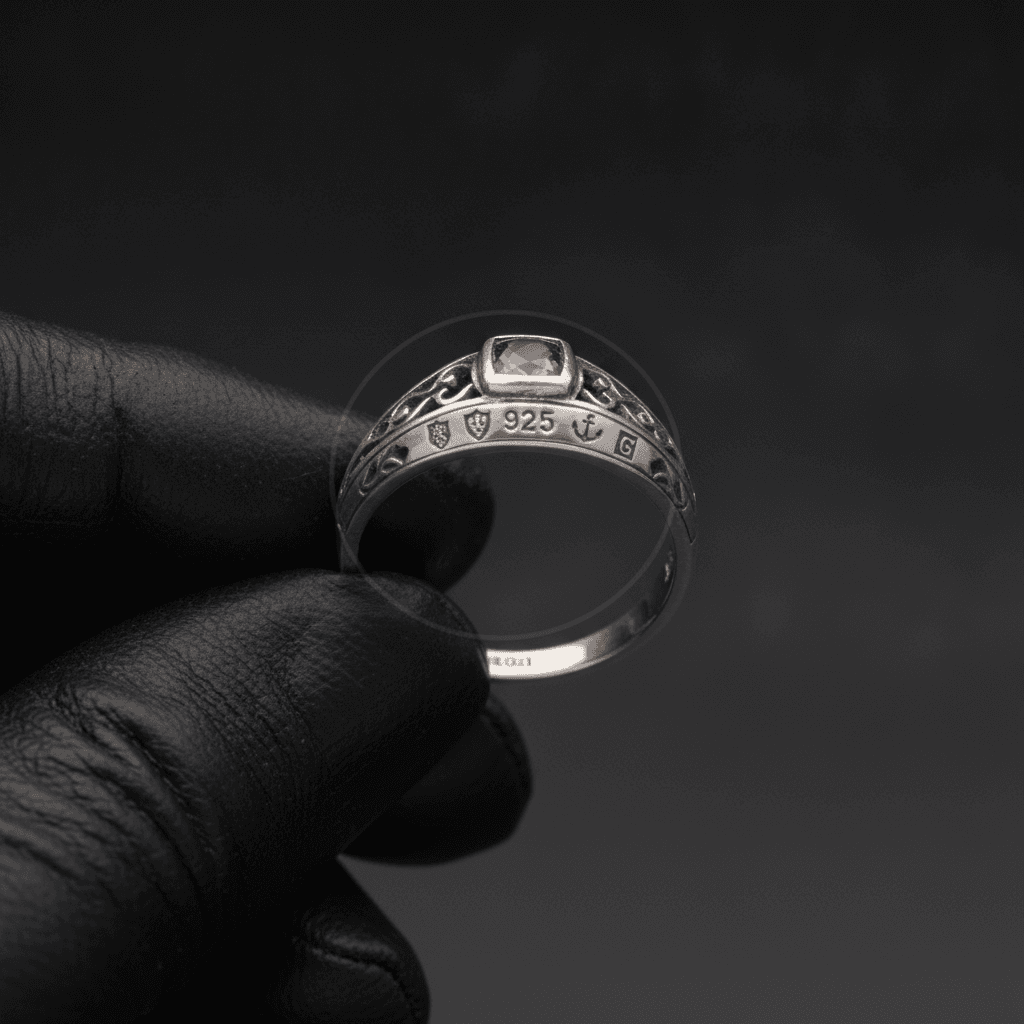
Begin with the vocabulary
People often call every jewelry stamp a hallmark, but the terms are not interchangeable. A quality or fineness mark states a claimed precious-metal proportion. A maker or trademark identifies a business associated with the mark. In a statutory hallmarking system, an official hallmark is a regulated set of marks applied after prescribed testing.
This distinction prevents a common error: treating a lone 925, 585, 750, or 14K stamp as if it independently authenticated the entire object, maker, country, date, gemstones, and value. It does none of those things by itself.
Photograph before interpreting
Use bright, indirect light and take a wider photograph that shows where the mark appears. Then make sharp macro images of every letter, number, symbol, border shape, and adjacent stamp. Photograph the same component from more than one angle because shallow impressions can look different as the light moves.
Do not aggressively polish a faint mark. Polishing can remove surface detail and historic finish. Do not scratch or file the item to expose metal. If the mark is hidden by a stone, hinge, or stuck clasp, do not force the mechanism.
Record whether the mark is inside a ring, on a clasp tongue, on a small chain tag, behind a pendant, on an earring post, or on a detachable back. Location matters because jewelry can be assembled from components with different origins and materials.
Read the marking system, not an isolated symbol
In the current UK system, official guidance describes three compulsory components of a complete hallmark: the sponsor's or maker's mark, the metal-and-fineness mark, and the assay-office mark. A date letter and traditional fineness symbol are optional. Weight exemptions and other rules also apply. A date letter therefore should not be expected on every modern UK-hallmarked item.
U.S. FTC guidance uses a different framework. It explains karat marks for gold, 925 or sterling descriptions for silver, platinum markings, and the name or registered trademark of the party standing behind certain quality marks. The U.S. framework should not be retrofitted onto a British, French, Italian, or other object.
First identify the likely jurisdiction and period. Then use current government, assay-office, hallmarking-convention, trademark-office, or well-documented maker-archive references. Do not rely on an uncredited image chart that strips symbols from their border, date cycle, or legal context.
What common fineness numbers claim
Parts-per-thousand marks express a claimed proportion of the named precious metal. For example, 925 commonly states 925 parts silver per thousand, while 585 and 750 commonly state 585 or 750 parts gold per thousand. The surrounding shape, letters, and system help identify which metal and rule apply. A bare 950 can appear in silver or platinum contexts, so surrounding evidence is essential.
Karat marks divide a gold alloy into 24 parts. Thus 18K claims 18 of 24 parts gold, or 75 percent. These marks describe fineness, not whether the object is hollow, plated, filled, repaired, or uniform across every component.
Maker, sponsor, assay, and date marks
A UK sponsor mark identifies the person or business that submitted the article for hallmarking; it does not always identify the designer who physically made it. An assay-office mark identifies the office that tested and marked the article. A date letter, when present, identifies the hallmarking year under the relevant cycle, not necessarily the year the entire object was designed or assembled.
In other systems, a maker or responsibility mark may operate differently. Initials are rarely unique enough to identify a famous house without the shape, registration, jurisdiction, and object context. Similar marks can belong to unrelated firms.
What marks cannot prove
A genuine mark on a clasp cannot prove the pendant uses the same alloy. A quality mark cannot identify a gemstone or treatment. A maker signature cannot by itself establish that the whole object is authentic, unaltered, or from a desired period. Marks can be worn, incomplete, copied, added later, or applied to replacement parts.
Corroborate marks with construction, metal testing, measurements, condition, provenance, and appropriate specialist comparison. If a consequential decision depends on purity, official assay or qualified testing is stronger than visual interpretation alone.
A repeatable research workflow
- Photograph the entire object and exact mark location.
- Transcribe only characters you can actually see; mark unclear positions with a question mark.
- Identify likely country, object type, and age range without forcing a conclusion.
- Separate fineness, maker or sponsor, assay-office, import, patent, design, and date elements.
- Check official references for that jurisdiction and period.
- Compare all components and look for repairs or replacements.
- Record both the interpretation and what remains unknown.
The responsible takeaway
Hallmarks are compact evidence, not a complete biography. Reading the full set in the right legal and physical context can narrow material and origin research while keeping authenticity, date, gemstone identity, and value as separate questions.
Want more jewelry knowledge?
Download our app for quizzes, care guides, and AI identification