Retro Jewelry of the 1940s: Identification and Dating Clues
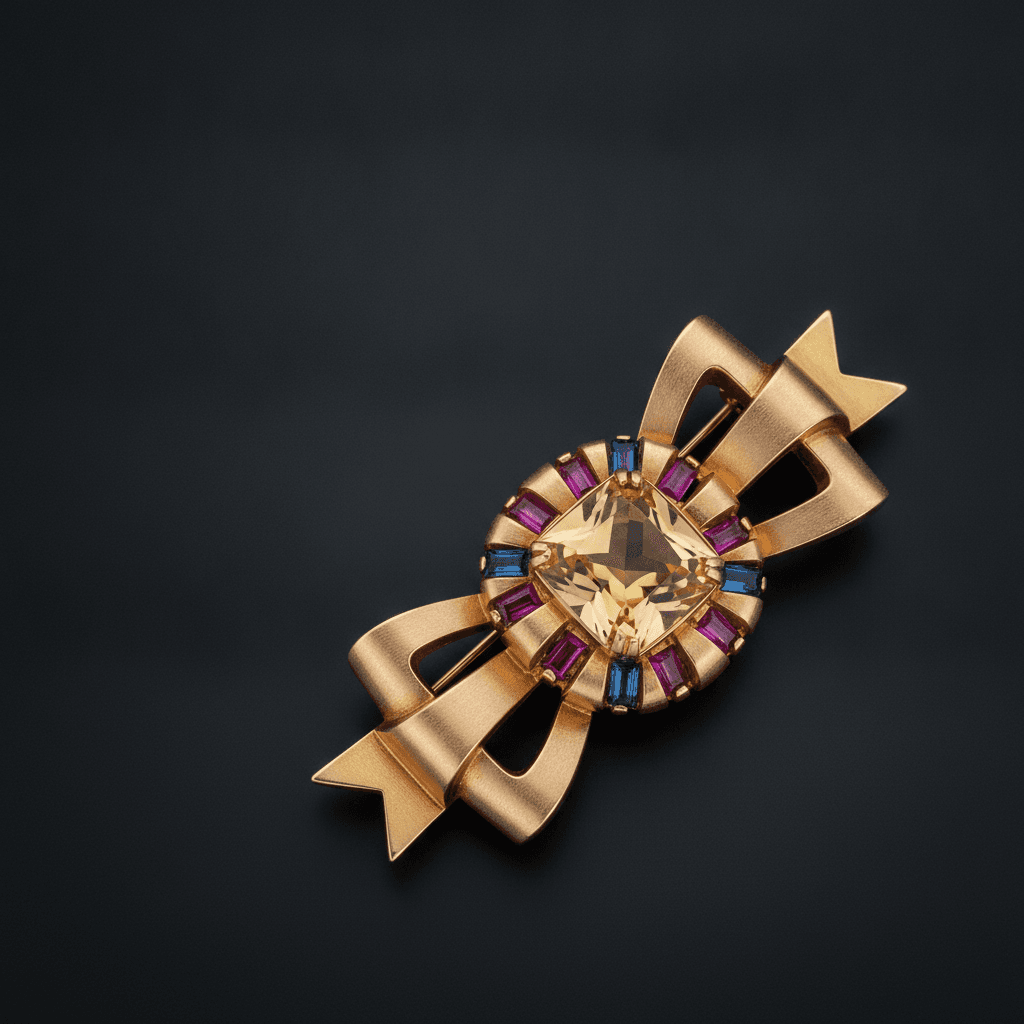
Retro describes a transition, not a single wartime formula
Retro jewelry is most closely associated with the 1940s, though examples and influences can cross the boundaries before and after the decade. GIA's study of modern jewelry describes 1940s Retro work as retaining Art Deco's bold lines while softening color contrasts and curving sharp geometry. Later in the decade, heavier settings could give way to more flexible, gemstone-led or handmade forms that continued into the 1950s.
The Second World War affected access to platinum and gemstones, but the impact varied by country, year, maker, and market. Do not present every gold bracelet as a direct response to one material shortage or assume that no platinum jewelry was made.
Visual tendencies
Common Retro characteristics can include:
- substantial yellow, rose, or differently colored gold alloys;
- rounded, scroll-like, ribbon, bow, fan, buckle, knot, and floral forms;
- volume and three-dimensional modeling rather than the flatter geometry associated with some Art Deco work;
- contrasting polished and textured surfaces;
- colored stones, cabochons, and diamonds used within strong metal forms;
- clips, brooches, double clips, bracelets, rings, and convertible designs;
- mechanical, architectural, naturalistic, or figurative motifs interpreted with curves.
These features overlap with earlier and later jewelry. Rose gold is not a date stamp. A large colored stone may be natural, synthetic, treated, glass, or another simulant, and its identity cannot be established from a photograph.
How Retro differs from Art Deco
Art Deco jewelry of the 1920s and early 1930s often emphasizes crisp geometry, symmetry, platinum or white metal, and high color contrast. Retro commonly appears warmer, heavier, more curved, and more sculptural. GIA notes that early Retro inherited Deco geometry but gradually softened it.
The distinction is not a clean overnight change. Jewelry made near the transition can combine flat geometric elements with curved gold. Later revivals can quote either style. Describe the specific evidence rather than forcing a piece into one decade.
How it differs from 1950s and 1960s work
GIA's historical survey describes 1950s jewelry with colorful arrays of faceted gems, beads, cabochons, and rough-tumbled stones, followed by greater emphasis on overall form and individual craftsmanship in the late 1950s and early 1960s. A 1940s-style scroll brooch and a 1950s wire-set gem cluster may share gold and color but use different structure and visual priorities.
Mid-century studio jewelry also developed through maker-led abstraction and industrial materials. An asymmetrical brass neckpiece may belong to that history rather than Retro fine jewelry.
Examine construction and fittings
Photograph the complete front, reverse, side, pin, hinge, clasp, clip mechanism, joins, stone settings, and every mark. Record dimensions and weight. Double clips and convertible fittings can be informative, but mechanisms were patented, copied, repaired, and reused.
Look for:
- maker and assay marks interpreted in their jurisdiction;
- patent or design numbers;
- evidence of casting, fabrication, hollow construction, or assembly;
- replaced pin stems, safety catches, ring shanks, and earring backs;
- solder color or tool marks suggesting repair;
- wear consistent with the proposed function;
- original receipts, catalogs, advertisements, cases, or photographs.
A signed piece still requires comparison with known examples because signatures can be imitated and components can be combined. An unsigned piece is not necessarily low quality or inauthentic.
Synthetic stones are not automatically replacements
Synthetic rubies, sapphires, spinels, and other manufactured materials were used in historical jewelry and can be period-appropriate. Their presence does not automatically mean a piece is modern or deceptive. Conversely, a natural stone does not prove a 1940s date because gems are frequently reset.
Use qualified gemological testing for identity and treatment. Describe “red transparent stone” or “blue cabochon” until the material is confirmed.
Care and condition
Substantial appearance can hide hollow sections, old solder, worn hinges, and stressed clip mechanisms. Do not bend a clip repeatedly to test it. Inspect prongs and articulated parts before wear. Avoid ultrasonic or steam cleaning until gems, treatments, adhesives, and repairs are known.
Preserve textured, brushed, florentine, or oxidized finishes. Aggressive polishing can flatten detail and change the contrast that defines the design. Store heavy pieces separately so they do not dent or scratch neighboring jewelry.
Value needs object-specific evidence
Do not attach broad price ranges to Retro jewelry. Value varies with maker, design, material, gemstone identity and quality, condition, rarity, provenance, completeness, alteration, and the current market. A famous house attribution requires evidence, and an asking price is not a completed sale.
A useful identification statement
“Rose- and yellow-colored metal brooch with a three-dimensional scroll form, blue cabochon, double-clip fitting, and partial maker mark. The design is consistent with 1940s Retro jewelry, but date, maker, metal, stone, and repairs remain to be confirmed.”
That format preserves the style insight while keeping authentication separate from appearance.
Want more jewelry knowledge?
Download our app for quizzes, care guides, and AI identification