Jewelry Hallmarks by Country: Why the Same Stamp Can Mean Different Things
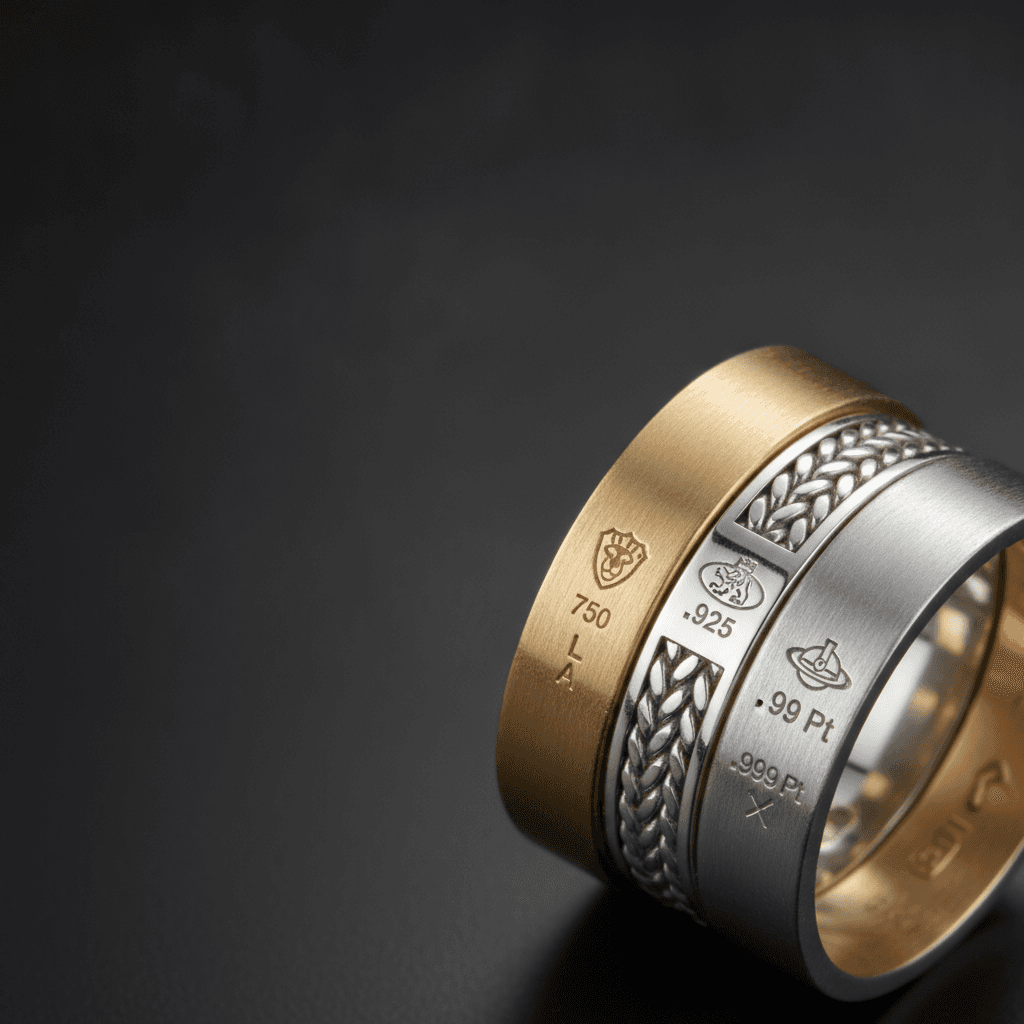
There is no universal hallmark language
A number such as 925, 750, or 950 can appear on jewelry from many markets, but the surrounding legal system determines what the mark represents and which other elements should be present. Some countries require independent third-party hallmarking for covered precious-metal articles. Others rely more heavily on manufacturer or seller quality marks. Some participate in an international convention, and exemptions may depend on metal, weight, age, or product type.
This is why a country-by-country guide should begin with method rather than a giant table of symbols. Symbols and rules change. A mark can also be a responsibility mark, import mark, date mark, design registration, patent number, model number, or private maker signature rather than a metal guarantee.
United Kingdom: a complete statutory hallmark
Current UK government guidance says a complete hallmark has three compulsory components: a sponsor's or maker's mark, a metal-and-fineness mark, and an assay-office mark. A traditional fineness symbol and date letter are optional. The sponsor is the person or business that submitted the article for hallmarking, which is not always the craftsperson who physically made it.
The fineness number is expressed in parts per thousand and appears in a shape indicating the metal. The assay-office mark identifies which recognized office tested and hallmarked the article. Current rules include minimum-weight exemptions: an absence of a hallmark is therefore not enough to date or condemn every small item.
Use the official Dealer's Notice and British Hallmarking Council guidance for current marks. For historic marks, consult the relevant assay office and period-specific official references. A current symbol chart should not be assumed to cover every historical cycle.
United States: quality marks and the responsible business
FTC consumer guidance explains the karat quality system for gold, silver terms such as sterling and 925, and qualified platinum descriptions. It also tells consumers to look near certain gold and silver quality marks for the name or U.S. registered trademark of the company standing behind the mark.
That is not the same structure as the British three-component official hallmark. A U.S. 14K or 925 quality mark is a material claim within the U.S. framework; it is not an assay-office date code. Conversely, a British sponsor mark should not be searched as if it were automatically a U.S. designer signature.
The Precious Metals Convention and Common Control Mark
The Convention on the Control and Marking of Articles of Precious Metals is an international treaty among Contracting States. Its Common Control Mark, or CCM, is applied by an authorized assay office after independent third-party control. Convention information explains that the CCM appears with the national assay-office mark, responsibility mark, and fineness mark and enables recognition among Contracting States.
The CCM does not create one global marking law. It applies within the Convention framework and covers precious-metal control, not gemstone identity, health, security, maker attribution, age, or financial value. Check the current member list and authorized offices at the Convention's official website rather than assuming every European country participates or uses identical domestic rules.
Researching another country responsibly
First identify the likely country from provenance, language, mark style, seller records, and construction—without treating any one clue as final. Then find the current national regulator, assay office, customs authority, standards body, or trademark register. Confirm whether hallmarking is compulsory, voluntary, or limited; which metals and weights are covered; what marks are responsibility versus official control; and whether historical systems differ.
Avoid crowd-sourced charts that show a symbol without its border shape, date cycle, or source. Do not copy claims such as “this animal always means 18K” across every year and object type. If a page cannot identify the issuing authority and version of its information, use it only as a lead.
Imported, repaired, and composite jewelry
An item can be made in one country, assayed in another, imported into a third, and repaired later. A chain, clasp, pendant, detachable back, or replacement fitting may carry its own mark. Convention marks can facilitate cross-border recognition, while national import and exemption rules add context.
Record each mark and its location before deciding which system applies. If the marks conflict, that may indicate a replacement component, later alteration, or a misread stamp rather than immediate fraud.
What no country mark proves alone
Even a genuine official hallmark addresses precious-metal fineness under its system. It does not identify a gemstone, guarantee an attributed designer, document provenance, establish an item's current condition, or set monetary value. A copied or counterfeit mark is also possible.
For a consequential purchase or sale, corroborate the mark with construction, documentation, appropriate metal testing, and specialist expertise. Keep conclusions narrow: “the mark is consistent with” is more responsible than claiming a complete origin story from one stamp.
A cross-border hallmark workflow
- Photograph the complete object and every mark location.
- Transcribe exact visible characters and shapes.
- Identify the likely jurisdiction and period.
- Separate quality, responsibility, assay, date, import, and private marks.
- Use official current and historical references for that system.
- Check exemptions and whether separate components differ.
- State what the marks support and what remains unproven.
The responsible takeaway
Country context turns a stamp from a tempting guess into usable evidence. Compare systems carefully, use the responsible authority, and never treat a fineness number as a worldwide certificate of identity, age, or value.
Want more jewelry knowledge?
Download our app for quizzes, care guides, and AI identification