Precious vs. Semi-Precious Gemstones: What the Labels Really Mean
Short answer
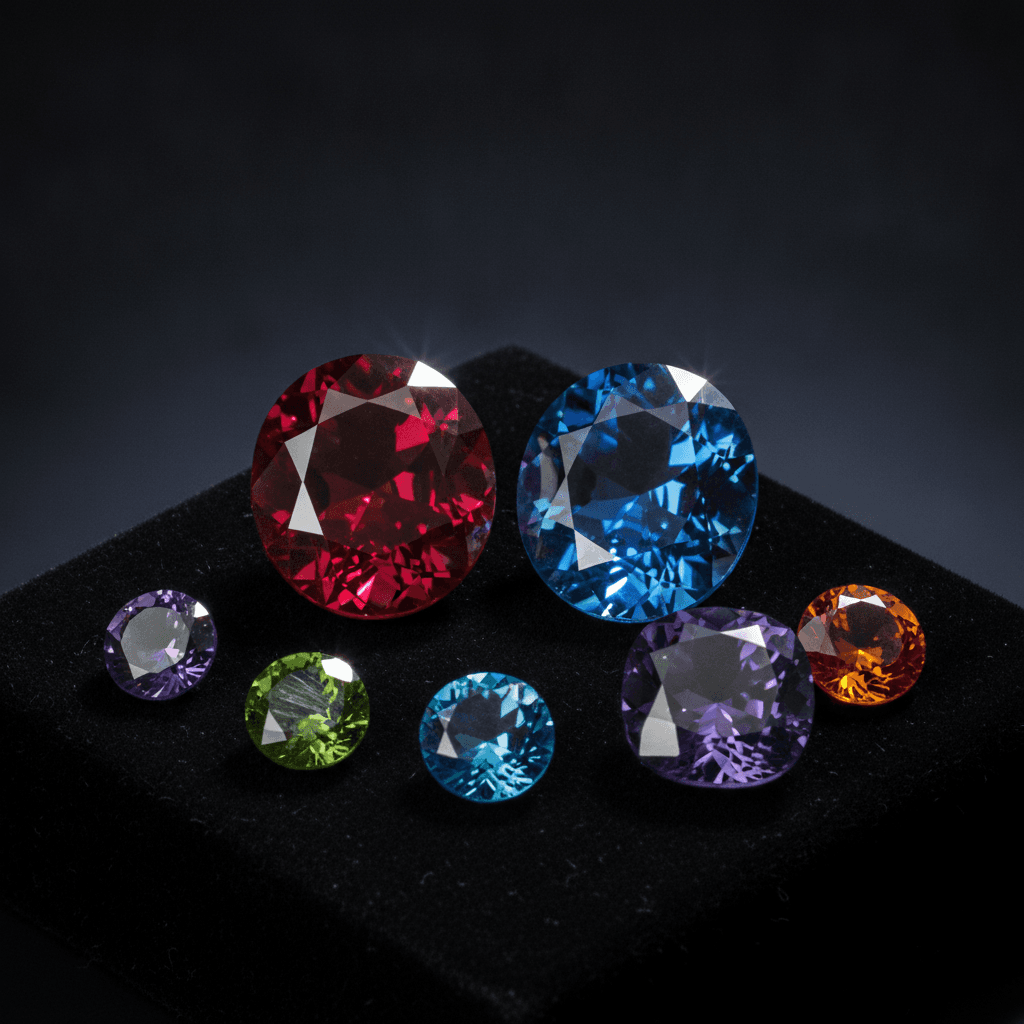
The labels precious and semi-precious are traditional categories, not scientific grades and not reliable statements of value. Diamond, ruby, sapphire, and emerald are commonly placed in the precious group, while many other gem materials are called semi-precious. That split can be convenient in casual conversation, but it does not tell you whether an individual stone is natural, treated, durable, rare, well cut, or valuable.
GIA has criticized the outdated implication that a gem described as semi-precious must be less beautiful, rare, or valuable. Modern gem references usually identify the material by its specific name and describe the qualities that matter for that material. A report might say natural spinel, laboratory-grown sapphire, or turquoise with impregnation rather than rely on a broad status label.
What the traditional labels include
In the familiar four-stone convention, diamond, ruby, sapphire, and emerald are called precious stones. Everything from amethyst and aquamarine to jade, opal, spinel, topaz, tourmaline, and zircon may be grouped under semi-precious stones.
This is not a complete mineralogical classification. Ruby and sapphire are both varieties of corundum, for example, while emerald and aquamarine are varieties of beryl. Pearl is an organic gem material rather than a mineral. Jade is an umbrella term that can refer to jadeite or nephrite. A two-bucket label hides these meaningful differences.
The word precious also appears in ordinary language to mean treasured or important. That emotional use is valid, but it should not be confused with a gemological determination or a promise about market value.
Why the labels do not rank value
Gem value is specific to the material and the individual specimen. Color, transparency, clarity characteristics, cut, size, treatment, natural or laboratory-grown origin, geographic origin when it can be supported, condition, documentation, and current demand can all matter. The relative importance of those factors changes by gem type.
A poor example from a traditionally precious category is not automatically worth more than an exceptional example from the semi-precious group. Likewise, a famous gem name does not establish quality. Country or mine names should not substitute for independent evidence, and a photograph cannot establish origin or treatment.
Avoid fixed price-per-carat tables in general educational guides. Prices change with quality, market, date, seller, and the evidence supplied with the stone. A current comparable for one gem is not a valuation rule for another.
Why the labels do not rank durability
Durability has more than one part. Hardness describes resistance to scratching. Toughness describes resistance to breaking and chipping. Stability describes how a material responds to heat, light, chemicals, and humidity. GIA emphasizes that the Mohs scale measures only hardness and is not linear.
This matters because a hard gem can still have cleavage or fractures that make it vulnerable to impact. A softer gem may perform well in a protected setting when worn with care. Treatments can also change cleaning requirements. The precious or semi-precious label tells you none of this.
Better questions to ask about a gemstone
When researching a loose stone or jewelry piece, replace the broad label with questions that can lead to evidence:
- What gem material does the seller claim it is?
- Is it represented as natural, laboratory-grown, assembled, or an imitation?
- Are treatments disclosed, and do they create special care requirements?
- Is the stone loose or mounted, and what can the setting conceal?
- Which color, clarity, cut, and size factors matter for this specific material?
- Is a report from an independent gemological laboratory appropriate for the decision?
- What is the return policy if the description cannot be confirmed?
These questions are especially important for online purchases. Color on a screen varies with lighting, white balance, editing, and display settings. Similar-looking materials can require instrument-based testing to separate.
How to describe a stone accurately
Use the narrowest description supported by evidence. If you only have photographs, describe observable facts such as color, shape, transparency, setting style, visible wear, and legible marks. Use conditional language for an identification hypothesis. Do not turn a resemblance into a claim of natural origin, treatment status, mine origin, or value.
For selling, the U.S. Federal Trade Commission Jewelry Guides address deceptive descriptions of gem materials, treatments, and manufactured products. Sellers should use terminology that clearly communicates what the product is. A buyer should keep the listing, invoice, report number, and treatment disclosure together.
The practical conclusion
Precious and semi-precious can describe a historical convention, but they should not drive a purchase, care decision, or appraisal. Specific identity and documented characteristics are more useful than category prestige. If the distinction matters because money, insurance, or authenticity is at stake, ask for material-specific evidence and independent testing rather than a stronger adjective.
Want more jewelry knowledge?
Download our app for quizzes, care guides, and AI identification