Mohs Hardness Scale for Gemstones: What It Measures and What It Misses
Short answer
The Mohs scale compares a mineral's resistance to scratching. It does not measure resistance to breaking, chipping, heat, light, chemicals, or humidity. Those other properties are why a high Mohs number does not automatically make a gemstone safe for every setting, activity, or cleaning method.
GIA divides gemstone durability into three ideas: hardness, toughness, and stability. Use all three before deciding how to wear, store, clean, or repair a piece.
The ten reference minerals
Friedrich Mohs introduced the relative hardness scale in the early nineteenth century. The familiar reference minerals are:
- Talc
- Gypsum
- Calcite
- Fluorite
- Apatite
- Orthoclase feldspar
- Quartz
- Topaz
- Corundum, including ruby and sapphire
- Diamond
A material higher on the scale can scratch a material lower on the scale under suitable conditions. This relationship is useful for understanding abrasion, but intentional scratch testing is a poor way to identify jewelry. It can damage a gem, a polished surface, a treatment, a mounting, or the object used for the test. Identification should use non-destructive professional methods.
The scale is relative, not linear
The numerical steps are not equal. A diamond at 10 is not simply one unit harder than corundum at 9. GIA explains that diamond is many times harder in scratch resistance. The scale ranks order; it is not a percentage and should not be used as one.
This also means that adding or averaging Mohs numbers has no useful consumer meaning. A ring with a diamond and an opal does not have an average hardness. Each component needs its own care plan, and the harder stone may scratch the softer one during storage.
Hardness is not toughness
Toughness is resistance to breaking and chipping. Crystal structure, cleavage, fractures, inclusions, shape, and setting all influence how a gem responds to impact.
Topaz illustrates the distinction. It ranks 8 for hardness, so it resists many scratches, but it has cleavage and can split from a hard blow or sharp temperature change. Diamond is the hardest gem, yet it can cleave or fracture in vulnerable directions. Nephrite jade has a lower Mohs number but exceptional toughness because of its interlocking structure.
Do not describe a high-hardness gem as indestructible. Rings and bracelets receive more impact and abrasion than earrings or pendants, and an exposed corner can be vulnerable even when the material is hard.
Stability adds heat, light, chemicals, and humidity
Stability describes how a gem reacts to environmental conditions. Some gem materials or treatments can be damaged by high heat, sudden temperature changes, strong light, household chemicals, solvents, or low humidity.
Opal can craze or fracture with intense heat or abrupt temperature change. Turquoise can discolor from chemicals, cosmetics, oils, or perspiration. Some treated stones have fillers or coatings that require gentler cleaning than an untreated example of the same material. The Mohs number does not reveal any of these sensitivities.
Common gemstone hardness ranges
Reference values can help you ask better questions:
- Diamond: 10
- Ruby and sapphire: 9
- Alexandrite: 8.5
- Topaz: 8
- Aquamarine and emerald: about 7.5 to 8
- Tourmaline: about 7 to 7.5
- Quartz varieties such as amethyst: 7
- Garnet: about 6.5 to 7.5, depending on type
- Tanzanite: about 6 to 7
- Jadeite: about 6.5 to 7; nephrite: about 6 to 6.5
- Opal: about 5 to 6.5
- Turquoise: about 5 to 6
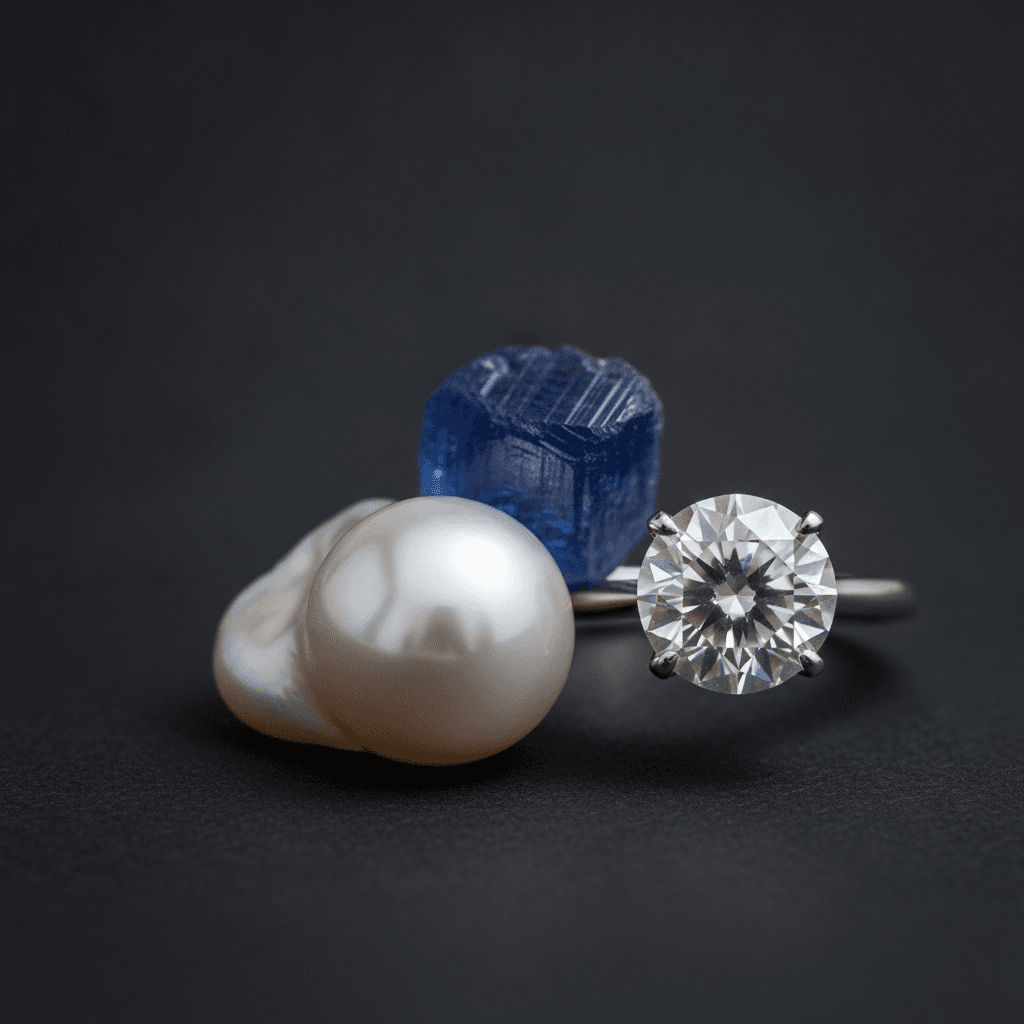
- Pearl: about 2.5 to 3
Ranges matter because gem names can cover groups or varieties with different properties. Values also do not account for an individual stone's fractures, treatments, or condition.
Using hardness for daily wear
There is no universal rule that every gem at 7 or above is suitable for daily rings or that every gem below 7 must be limited to pendants. Start with how the piece will be used. Consider the wearer's work, sports, household tasks, likelihood of impact, setting protection, replacement difficulty, and willingness to accept surface wear.
A protective design can reduce some risks but cannot change the gem's physical properties. Remove jewelry before activities that can crush, strike, abrade, heat, or chemically expose it. Ask a jeweler to inspect loose stones and worn prongs rather than assuming the gem is the only vulnerable component.
Storage and cleaning decisions
Store pieces separately so diamonds, corundum, and other hard surfaces do not rub against softer gems or metal. Soft pouches and divided compartments reduce contact. Avoid stacking pieces tightly during travel.
Choose cleaning advice for the complete piece, not just the hardest material in it. The setting may contain several gems, enamel, adhesives, filled fractures, coatings, or delicate metalwork. Warm soapy water is commonly recommended for many intact gems, but it is not a universal instruction. When identity or treatment is uncertain, document the piece and ask a qualified jeweler before using ultrasonic, steam, heat, solvents, or chemicals.
The practical conclusion
The Mohs scale is a valuable scratch-resistance reference when used within its limits. It cannot authenticate a stone and cannot predict total durability on its own. Combine hardness with toughness, stability, treatment status, setting design, and actual condition. That fuller picture leads to safer choices than a single number.
Want more jewelry knowledge?
Download our app for quizzes, care guides, and AI identification