How Colored Gemstones Are Evaluated: Color, Clarity, Cut, and Size
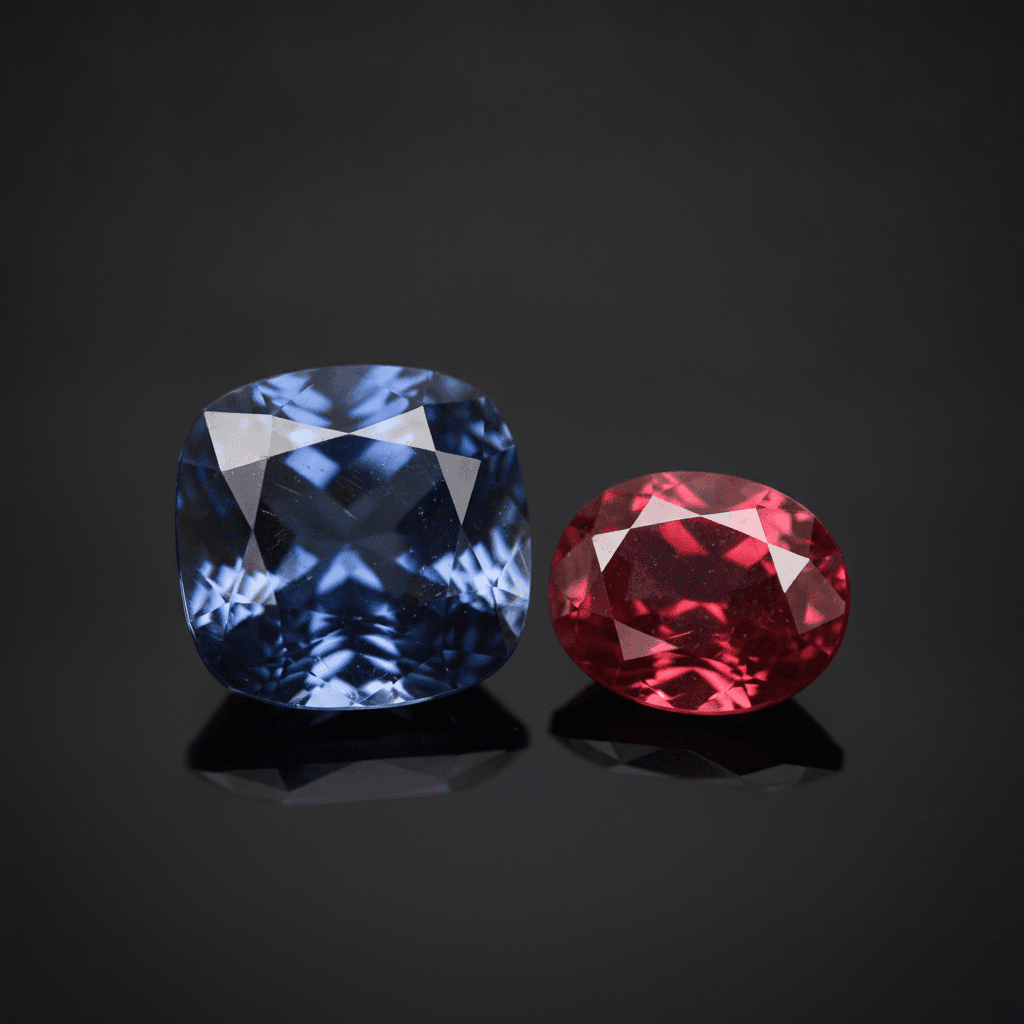
Short answer
Color, clarity, cut, and carat weight are useful headings for examining a colored gemstone, but they do not create one universal grade. The same observation can have a different meaning in ruby, emerald, opal, tourmaline, or aquamarine. GIA teaches these factors as part of colored-stone evaluation while also explaining that material identity, treatments, durability, rarity, and market conditions can affect the final judgment.
That makes this framework a research checklist, not a do-it-yourself appraisal formula. A photograph can document appearance, but controlled observation and gemological testing are needed to establish many of the facts behind that appearance.
Color: describe before you rank
Colored-stone professionals consider hue, tone, and saturation. Hue is the basic color impression and any visible modifiers. Tone describes how light or dark the gem appears. Saturation describes the strength or intensity of its color.
There is no safe rule that the purest hue or darkest tone is always best. Preferred color ranges are specific to a gem variety, and a stone can become so dark that brightness is lost. Pleochroic gems may show different colors in different crystal directions. Color zoning, cut orientation, lighting, and surrounding metal can change the face-up impression.
Record color under neutral, repeatable lighting and view the whole stone rather than one edited photograph. Do not infer geographic origin or treatment from color alone. Laboratories use observation and analytical instruments when those questions are part of the service.
Clarity: context depends on the material
Clarity concerns internal characteristics and surface-reaching features, but expectations vary widely. Some gem materials are commonly found with few eye-visible inclusions. Others often contain inclusions or fractures, and those characteristics may be accepted when the color and overall appearance are attractive.
Inclusions are not automatic proof that a stone is natural. Laboratory-grown gems can contain growth features, and natural stones can be unusually clean. Some inclusions help a trained laboratory identify a material, detect treatment, or study origin, but interpretation requires expertise and suitable equipment.
The practical questions are whether a feature is visible, whether it affects transparency or beauty, whether it reaches the surface, and whether it may affect durability. A seller's clarity label should not be treated as interchangeable across unrelated gem types.
Cut: appearance, weight, and structure interact
Cut includes shape, proportions, symmetry, polish, and how rough material was oriented. Colored-stone cutters often balance brightness, evenness of color, face-up size, weight retention, inclusions, and the crystal's directional color.
A shallow area can create a transparent-looking window. An overly deep or poorly oriented stone can look dark. Color zoning may become more or less visible depending on orientation. Some asymmetry can reflect the shape of valuable rough, but that does not mean workmanship is irrelevant.
Mounted stones are harder to evaluate because prongs, bezels, closed backs, dirt, and reflections can hide areas of the gem. Photographs from the face, side, and back can document these limits, but they cannot provide a complete cut analysis.
Carat weight and face-up size are not the same
Carat is a unit of weight. Different gem materials have different densities, so two stones with the same carat weight can have different millimeter dimensions. Cut depth also affects how large a stone looks from above.
Compare length, width, depth, and weight when those measurements are available. In a mounted piece, an estimated size from a photograph is not a measured carat weight. Settings can conceal the pavilion, and image scale can be unreliable.
Larger size can affect rarity and market demand, but the relationship is not a fixed multiplier. Quality, treatment, condition, documentation, and the specific market still matter.
Factors beyond the four headings
A useful evaluation also asks:
- Is the material natural, laboratory-grown, assembled, or an imitation?
- Are treatments present, and are they stable under normal care?
- Does the gem have cleavage, fractures, porosity, or sensitivity to heat and chemicals?
- Is a claimed geographic origin supported by an appropriate laboratory opinion?
- Does the report identify the stone, or does it also provide an origin opinion?
- What type of value is being discussed, and on what date and market?
GIA notes that its colored-stone identification reports identify a material, state whether it is natural or laboratory-grown, and name detectable treatments. GIA evaluates colored stones but does not issue a simple quality grade for every variety. A laboratory identification report is also not a financial appraisal.
A responsible buying workflow
Start by deciding what question matters. For a modest personal purchase, clear seller disclosure, careful inspection, and a return policy may be enough. For a consequential purchase, request an independent report whose scope matches the claim. Verify the report number with the issuing laboratory and make sure its description matches the item.
Use color, clarity, cut, and size to organize observations, not to produce an unsupported score. The strongest conclusion is often a list of verified facts plus clearly labeled uncertainties. That approach is more useful than a universal percentage formula and easier to update when better evidence becomes available.
Want more jewelry knowledge?
Download our app for quizzes, care guides, and AI identification