Garnet Colors and Varieties: A Practical Jewelry Guide
Short answer
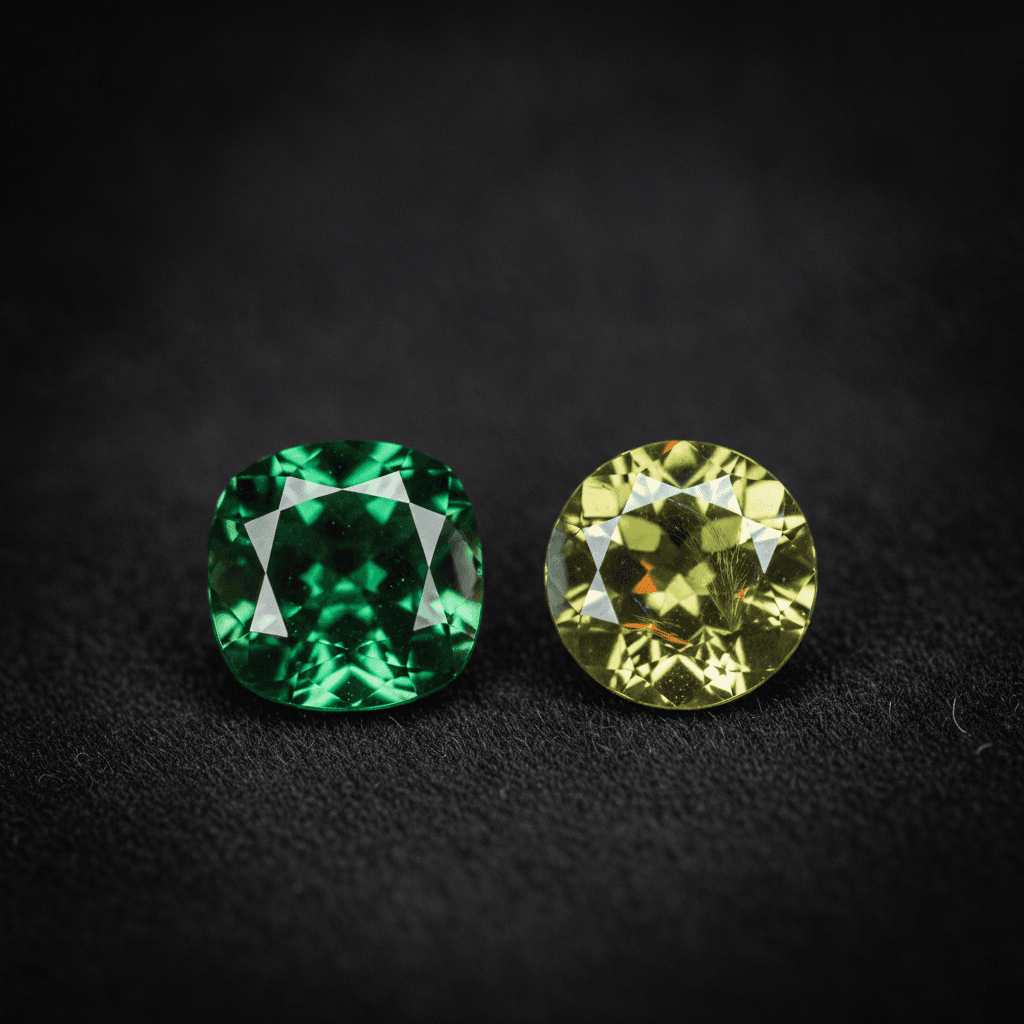
Garnet is a mineral group, not one uniformly red stone. Gem garnets can be red, orange, green, purple-red, pinkish, brown, and in rare cases show a color change. Familiar names such as almandine, pyrope, spessartine, grossular, and andradite describe species or compositions within the group; tsavorite, demantoid, and rhodolite are widely used variety names.
Color can suggest possibilities, but it cannot establish garnet species, natural origin, treatment, or geographic source. GIA uses gemological properties and, when needed, analytical testing. A photo should be treated as a record of appearance rather than an identification verdict.
Why garnet is a group
Garnets share a crystal structure while their chemistry varies. Many gem garnets are mixtures rather than perfectly pure end members. This helps explain the group's broad range of colors and properties.
Common red jewelry garnets are often associated with almandine and pyrope components. Spessartine is known for orange to reddish-orange appearances. Grossular includes green tsavorite as well as other colors. Andradite includes green demantoid. Rhodolite generally refers to attractive purplish-red garnet with pyrope and almandine components.
These names are useful vocabulary, but they do not form a simple ladder from low to high quality. Each variety has its own market and preferred appearance. A seller should identify a stone as narrowly as the evidence supports.
Color and optical effects
GIA describes garnets in almost every color. Green, orange, and intense purplish-red varieties can look very different from the dark red material many people associate with January's birthstone.
Some garnets change color under different light sources. That phenomenon should be observed with controlled lighting and described by the colors actually seen. A shift in a phone video can also come from automatic white balance, exposure, or editing, so it is not proof of a color-change garnet.
Demantoid can show strong dispersion, producing spectral flashes, but brilliance and fire depend on cut, transparency, color, and lighting. Horsetail-like inclusions are associated with some demantoids, yet an inclusion pattern in a photograph should not be used as a conclusive variety or origin test.
Quality factors vary by variety
Color is usually important, but preferred hue, tone, and saturation depend on the garnet type. A dark red stone that loses brightness in ordinary light should be evaluated differently from a vivid green tsavorite or an orange spessartine.
Clarity expectations also vary. Some garnets are commonly found with few eye-visible inclusions, while certain inclusions may be tolerated or appreciated in specific varieties. Examine whether a feature affects transparency, beauty, or durability rather than applying one generic clarity standard.
Cutters balance brightness, color, inclusions, and weight. Look for windowing, overly dark areas, uneven symmetry, chips, and facet abrasion. Compare millimeter dimensions with weight because density and cut depth influence face-up size.
Avoid generic price-per-carat claims. Variety, color, size, clarity, cut, treatment, report evidence, and the current market interact. Statements that a garnet is an investment or will appreciate are not gemological conclusions.
Natural, synthetic, treated, and imitated material
Garnets are not typically treated as often as some other colored stones, but treatment concerns are not impossible. GIA notes that fracture filling can occur rarely. Glass, synthetic materials, and other stones can imitate a garnet appearance.
A colored-stone identification report can name the material and detectable treatments. It does not replace a financial appraisal and does not turn a visual trade name into proof of mine origin. For a significant green, orange, blue-color-change, or historically important stone, independent testing can be proportionate to the claim.
Durability and suitable jewelry use
Depending on type, garnet hardness ranges from about 6.5 to 7.5 on the Mohs scale. GIA describes garnet toughness as fair to good. Garnets can work in all jewelry styles with proper care, but they should not receive hard blows or rough wear.
Daily-worn rings need more protection and inspection than earrings or pendants. Exposed corners, thin girdles, existing fractures, and loose prongs can increase risk. Remove garnet jewelry before sports, manual work, and household tasks that can strike or abrade it.
Cleaning and storage
Warm soapy water is generally the conservative cleaning choice for garnet in good condition. A soft brush can be used around a sound setting, followed by a careful rinse and dry. If the stone is fracture-filled, otherwise treated, or visibly damaged, ask a jeweler before cleaning it.
GIA says ultrasonic cleaning is usually safe except for fractured stones, while steam cleaning is not recommended. Because treatment and internal condition may be unknown in inherited jewelry, warm soapy water is the safer default. Fracture-filled stones should receive only gentle cleaning.
Store garnets separately from harder gems and from one another. Quartz dust and harder jewelry can abrade surfaces over time. A divided box or soft pouch reduces contact.
What to ask before buying
- Which garnet variety or composition does the seller claim?
- Is that name based on a laboratory report or a visual opinion?
- How does the stone look in neutral daylight-equivalent and indoor light?
- Are treatments or fracture filling known?
- Are there surface-reaching fractures, chips, or abraded facets?
- What are the dimensions as well as the carat weight?
- Does the return period allow independent testing?
The practical conclusion
The useful story of garnet is its mineral diversity, not a promise that every non-red example is rare or valuable. Learn the variety names, describe the observed color, and match care to the actual stone and setting. For claims that affect a major purchase, rely on independent identification rather than a color stereotype or a fixed price chart.
Want more jewelry knowledge?
Download our app for quizzes, care guides, and AI identification