Opal Play-of-Color: Patterns, Quality Factors, Treatments, and Care
Short answer
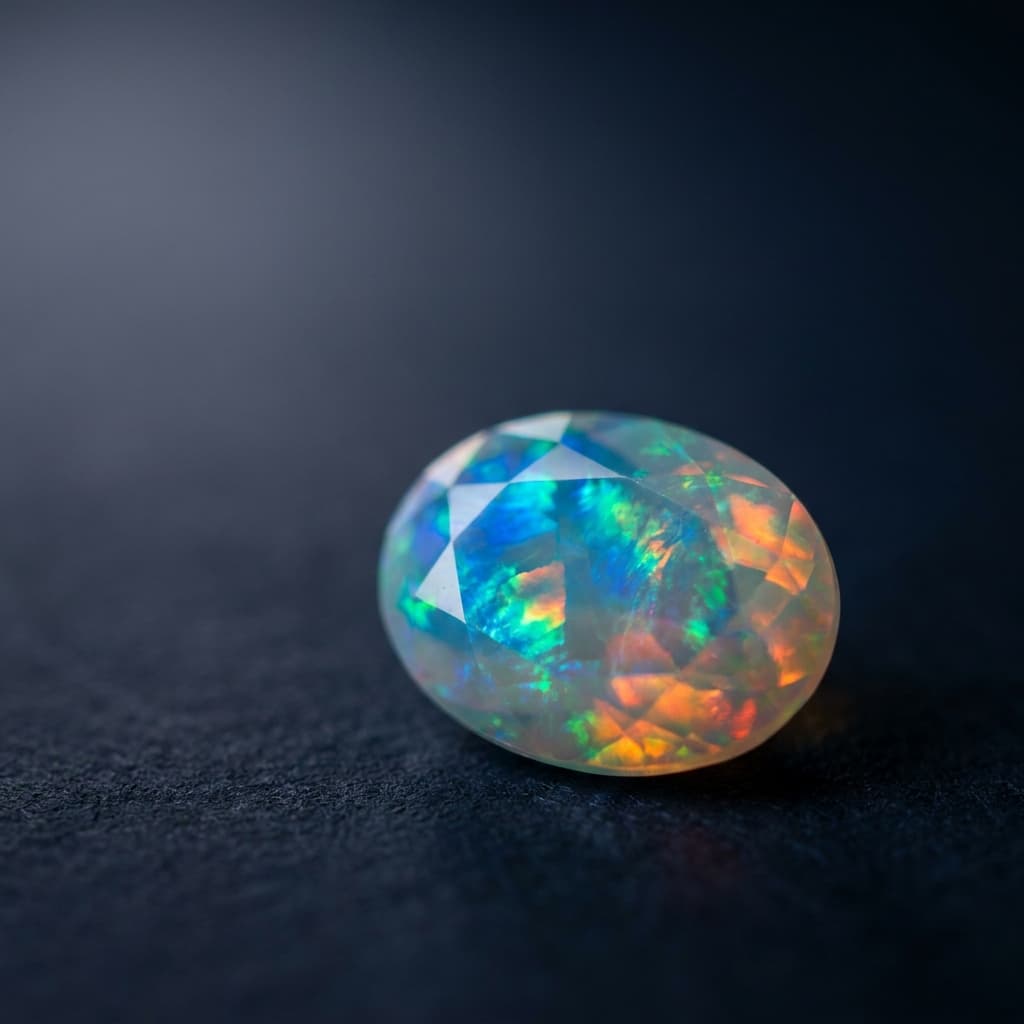
Play-of-color is the shifting display of spectral colors seen in precious opal. GIA explains that it results when light diffracts through an ordered arrangement of tiny silica spheres. Common opal lacks this play-of-color, although it can still have attractive bodycolor.
An opal should be evaluated for the complete face-up display, including brightness, color range, pattern, coverage, bodycolor, transparency, cut, condition, construction, and treatment. A single flash photograph can exaggerate one angle and is not enough for identity or quality comparison.
How play-of-color works
Opal is hydrated silica rather than a conventional crystalline gem. During formation, silica-rich material filled spaces in rock. In precious opal, regularly arranged silica spheres interact with light and separate it into visible colors. Sphere size and spacing influence which colors appear.
As the stone, viewer, or light moves, different parts of the structure meet the conditions for diffraction. That is why the colors seem to shift across the surface. The phenomenon is structural rather than a pigment distributed through the stone.
Descriptions such as pinfire, broad flash, rolling flash, and harlequin refer to visible pattern styles. These names can help record an appearance, but pattern boundaries and commercial use are not always standardized. Show the pattern in continuous, unedited video rather than relying only on a label.
Precious opal, common opal, and bodycolor
Precious opal displays play-of-color. Common opal does not. Both can occur in various bodycolors and degrees of transparency. Bodycolor is the background appearance against which play-of-color is seen.
Black opal describes dark body tone; it does not mean that every part of the gem is black or that the material comes from a particular mine. White or light opal has a lighter body tone, while crystal opal is transparent to semitransparent enough for play-of-color to be visible within it. Fire opal is named for yellow, orange, or red bodycolor and may or may not show play-of-color.
These categories can overlap in ordinary listings. Ask the seller to describe body tone, transparency, and play-of-color separately. Geographic origin should be treated as an evidence-based claim, not inferred from bodycolor.
Evaluating the visible display
Brightness and coverage matter because a colorful pattern that appears only at one narrow angle may present differently in normal wear. View the stone face-up and tilted under neutral light. Record which colors appear, how strongly they appear, and how much of the face they cover.
Red and orange flashes can attract market interest, but color alone does not determine quality. Pattern, brightness, coverage, body tone, transparency, size, cut, condition, and personal preference interact. Avoid universal claims that one color automatically establishes value.
Cut should support the display and protect the material. Many opals are cabochons, but profiles vary. Check for flat spots, excessive thinness, chips, pits, scratches, and fracture lines. A dark backing can change face-up contrast, so the side and back are essential views.
Solid opal, doublets, and triplets
A solid opal is one piece of opal material. A doublet bonds a thin opal layer to a backing. A triplet adds a transparent cap over a thin opal layer and backing. These assembled products can be attractive and durable for their intended use, but they must be described accurately because water, heat, impact, and aging adhesives can affect them differently.
Look at the side for straight layer boundaries, a dark backing, or a clear cap. A closed setting can hide construction, and a photograph may not resolve it. Do not pry the stone out or soak it to test the layers.
Opal can also be impregnated with oil, wax, or plastic, or receive sugar, smoke, dye, or other surface-related treatments. Synthetic opal and imitations exist. A laboratory report is the appropriate path when identity, construction, treatment, or origin matters.
Durability and crazing
GIA places opal around 5 to 6.5 on the Mohs scale, with toughness ranging from very poor to fair. It can scratch and break more readily than many common ring stones. Crazing describes networks of fracture lines that can develop, particularly with high heat, intense light, or sudden temperature change.
Do not assume that wearing an opal supplies protective moisture or that storing every opal in water prevents crazing. Different opal types and assembled pieces behave differently, and prolonged soaking can harm adhesives in doublets or triplets. Follow material- and construction-specific advice.
Cleaning and storage
GIA identifies warm soapy water as the safe cleaning method. Use a soft damp cloth or a very soft brush on a sound setting, rinse briefly when appropriate, and dry gently. Do not use steam or ultrasonic cleaners. Avoid high heat, abrupt temperature changes, harsh chemicals, and long soaking when construction is uncertain.
Store opal separately in a padded compartment. Protect it from diamonds, sapphires, and other harder materials, and avoid pressure on thin edges.
A practical buying checklist
- Request unedited video showing the stone moving under neutral light.
- Record brightness, color range, pattern, coverage, body tone, and transparency.
- Ask whether the item is solid opal, a doublet, a triplet, synthetic, or an imitation.
- Request disclosure of impregnation, smoke, sugar, dye, coating, or other treatment.
- Inspect the side and back for layers, chips, scratches, and crazing.
- Treat mine and geographic-origin claims as laboratory or provenance questions.
- Use a return period for independent examination when the purchase is consequential.
The practical conclusion
Understanding play-of-color makes opal easier to describe, but it does not remove the need to inspect construction, treatment, and condition. Evaluate the display across normal viewing angles, care for the whole object conservatively, and use a laboratory when the difference between solid, assembled, natural, synthetic, or treated material matters.
Want more jewelry knowledge?
Download our app for quizzes, care guides, and AI identification