Belle Époque Jewelry: Garland Style, Platinum, and Dating Clues
Start with the label's context
Belle Époque means “beautiful era” and describes a wider European cultural period rather than a regulated jewelry grade. Historians commonly connect it with late-nineteenth-century prosperity through the outbreak of the First World War, but exact dates vary by subject. In jewelry, the label often appears around French high-society work of the turn of the twentieth century.
The Victoria and Albert Museum dates Art Nouveau jewelry and the contrasting Garland style to about 1895–1910. British sources may call closely related elite diamond-and-platinum work Edwardian, while French and international descriptions may use Belle Époque. A piece can reasonably be discussed through more than one context, but the terms should not be treated as perfect synonyms.
Garland style versus Art Nouveau
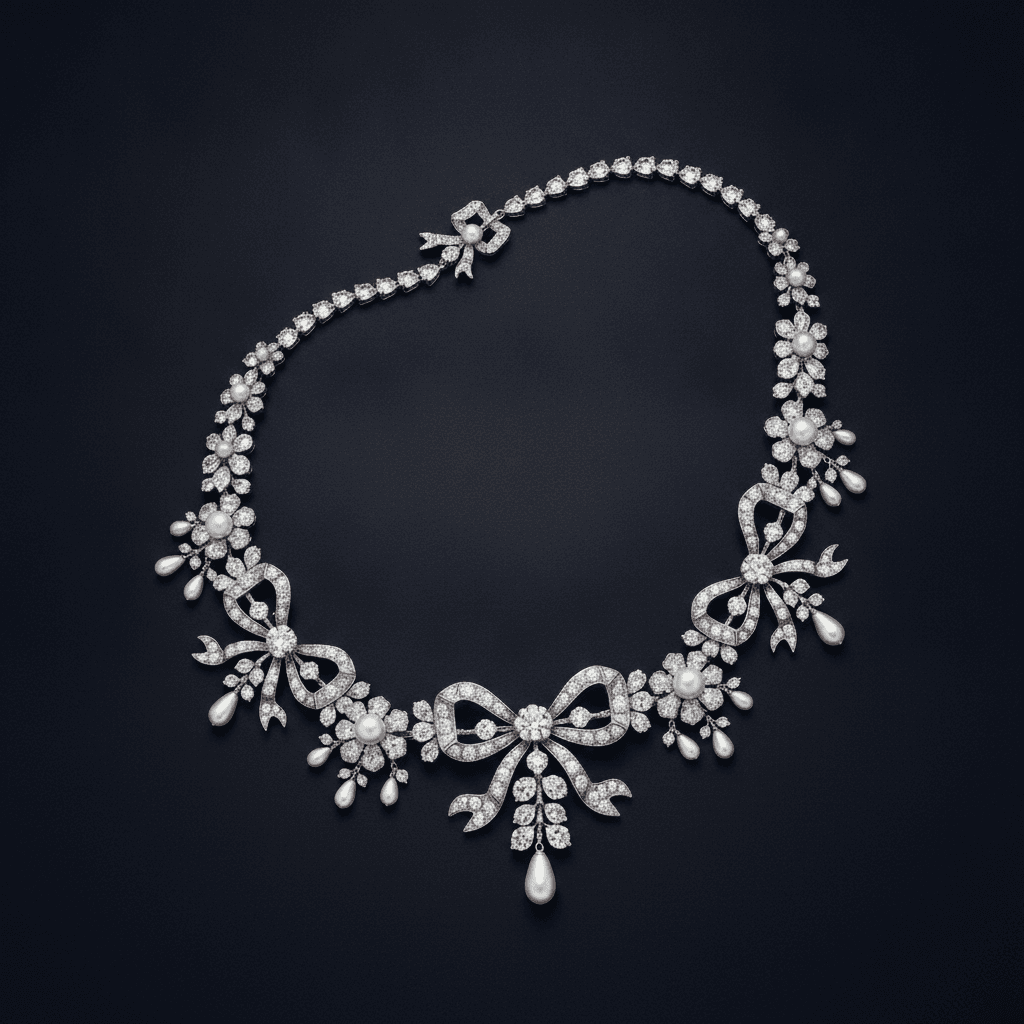
Two markedly different design currents existed at the same time. Garland-style jewelry reinterpreted eighteenth- and early-nineteenth-century court ornament through bows, ribbons, wreaths, swags, flowers, and lace-like openwork. White diamonds, pearls, and platinum often created a light, continuous surface with little visible metal.
Art Nouveau favored sinuous lines, asymmetry, plants, insects, the female figure, enamel, horn, glass, opal, and artistic material effects. The V&A explicitly contrasts Art Nouveau's radical visual language with Garland-style diamond jewelry. Do not call every turn-of-the-century floral piece Belle Époque Garland: look at symmetry, materials, line, and construction.
Features that can support a Garland-style description
Common visual clues include:
- symmetrical or carefully balanced compositions;
- ribbon bows, laurel wreaths, floral garlands, knots, scrolls, and drops;
- openwork that creates a lace-like effect;
- predominantly white diamonds and pearls, sometimes with restrained colored accents;
- fine beaded edges often described as milgrain;
- articulated sections and removable or convertible components;
- platinum used to support delicate-looking stone arrangements.
The Cleveland Museum of Art documents Belle Époque necklaces commissioned around 1895 and made with gold, platinum, and diamonds. That dated example combines metals rather than presenting a single-metal formula. A white surface might be platinum, silver, white gold from a later period, or plating; appearance alone cannot identify it.
Examine the reverse, not only the sparkle
Photograph the front under diffuse light, then capture the reverse, side profile, fastener, hinge, joins, stone backs, and every mark. The reverse can reveal whether the openwork was fabricated or cast, how articulated sections connect, whether a brooch fitting was replaced, and whether later repairs introduced different metal.
Record dimensions and weight. Note old-cut stones as observations, but do not date the piece from one cut. Diamonds were reused, settings were altered, and later revival jewelry copied period motifs. A genuine period stone can appear in a later mounting, while a Belle Époque piece can contain replacements.
Marks and provenance
Read hallmarks in the correct national system. A platinum mark, maker's signature, assay mark, inventory number, or fitted case can narrow research when it is complete and genuine. Partial marks should be photographed rather than aggressively polished. Compare them with official assay resources, maker archives, and cataloged museum objects.
Provenance is especially helpful: invoices, portraits, family letters, exhibition records, repair receipts, and old photographs can connect an object to a date. A famous house name on a box is not proof that the piece belongs to that box.
Distinguish period, revival, and inspired work
Garland and Edwardian motifs have remained popular. Later Art Deco pieces may retain bows and platinum while becoming more geometric. Mid-century, late-twentieth-century, and current jewelers have also produced faithful-looking revivals.
Use three separate statements when needed:
- Visual style: “Garland-style openwork with bow and wreath motifs.”
- Estimated date: “Possibly early twentieth century; not confirmed.”
- Material: “White metal and colorless stones pending testing.”
That wording is more defensible than declaring an object an authentic platinum Belle Époque diamond jewel from a photograph.
Care considerations
Delicate appearance does not guarantee intact construction. Old platinum wire, knife-edge elements, hinges, solder repairs, pearls, and narrow stone settings require inspection. Do not use ultrasonic or steam cleaning until every gem, treatment, and repair is understood. Avoid polishing marks or removing dark material that may reveal construction history.
Store the piece fully supported so drops and articulated parts do not pull on each other. Separate it from harder jewelry and preserve the fitted case and documents even if they are worn.
The responsible identification
Belle Époque jewelry is best described through its place, date evidence, Garland or Art Nouveau vocabulary, materials, construction, and provenance. The strongest conclusion may be a range—such as “turn-of-the-twentieth-century Garland style, possibly Belle Époque or Edwardian”—followed by the evidence still needed. That precision is more valuable than a confident but unsupported period label.
Want more jewelry knowledge?
Download our app for quizzes, care guides, and AI identification