Diamond Clarity Grades Explained: FL, IF, VVS, VS, SI, and I
Short answer
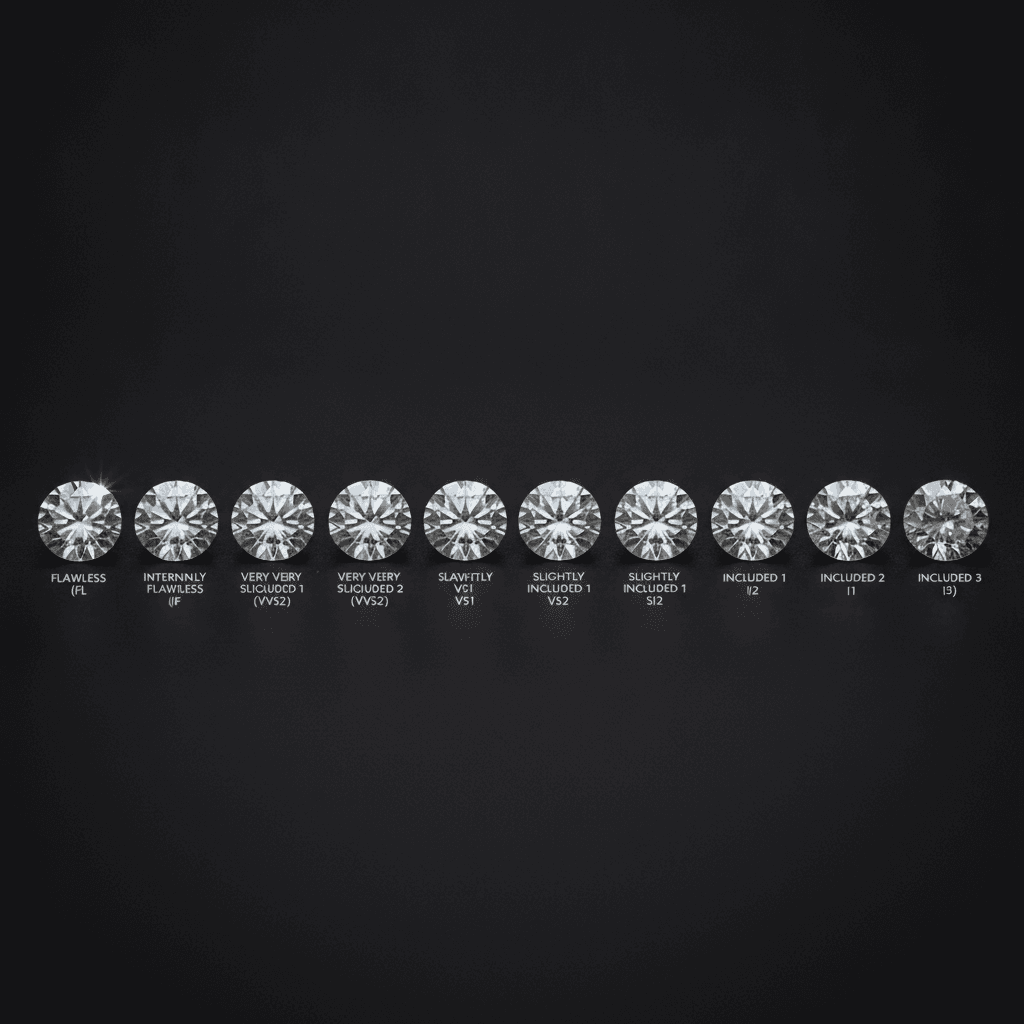
The GIA Diamond Clarity Scale has 11 grades: FL, IF, VVS1, VVS2, VS1, VS2, SI1, SI2, I1, I2, and I3. Skilled graders assess inclusions and blemishes using 10× magnification and consider their size, number, location, nature, and relief.
Clarity is one part of diamond quality. A grade does not by itself determine beauty, durability, price, natural or laboratory-grown origin, treatment, or whether a diamond is the best choice for a particular buyer. Use the complete grading report and inspect the individual stone.
Inclusions and blemishes
Inclusions are internal characteristics or features that extend into the diamond. Examples can include crystals, feathers, clouds, needles, cavities, and internal graining. Blemishes are surface characteristics such as scratches, polish lines, naturals, or extra facets.
The name of a feature does not determine the grade by itself. A small crystal under the table may affect visibility differently from several low-relief features near the edge. A feather's effect depends on size, location, orientation, relief, and whether it raises a durability concern.
Most characteristics are not identification fingerprints that a consumer can interpret from a phone photo. A plotted diagram documents approximate locations and types observed at grading, but it is not a complete map of every microscopic feature.
The five grading factors
GIA describes five factors used in clarity grading:
- Size: larger features tend to have more effect when other factors are equal.
- Number: more visible characteristics can increase the overall effect, though reflections are interpreted in context.
- Location: a feature near the center of the table may be more noticeable than one near the edge.
- Nature: the type and structure of the characteristic matter.
- Relief: stronger contrast with the surrounding diamond makes a feature easier to see.
These factors interact. Clarity grading is not produced by counting inclusions or measuring one feature in isolation.
The 11 GIA clarity grades
Flawless and Internally Flawless
Flawless, or FL, means no inclusions and no blemishes are visible to a skilled grader at 10× magnification. Internally Flawless, or IF, means no inclusions are visible, but blemishes are present at 10×.
These definitions refer to the grading conditions. They do not mean the diamond is physically perfect at every magnification or immune to later wear.
Very, Very Slightly Included
VVS1 and VVS2 contain minute inclusions that range from extremely difficult to very difficult for a skilled grader to see at 10×. The distinction depends on the combined grading factors, not merely on how many marks appear on a plot.
Very Slightly Included
VS1 and VS2 contain minor inclusions that range from difficult to somewhat easy for a skilled grader to see at 10×. Many will not be visible without magnification in ordinary viewing, but eye visibility depends on size, cut, lighting, observer, and the specific feature.
Slightly Included
SI1 and SI2 contain noticeable inclusions that are easy to very easy for a skilled grader to see at 10×. It is unsafe to promise that every SI1 is eye-clean or that every SI2 has visible inclusions. Examine the individual stone at the intended viewing distance and lighting.
Included
I1, I2, and I3 contain obvious inclusions at 10× that may affect transparency and brilliance. In some cases a feature can also have durability implications, but the grade alone does not diagnose structural safety. Ask a qualified jeweler or gemologist to assess vulnerable features and setting plans.
What eye-clean means
Eye-clean is an informal viewing description, not a GIA clarity grade. Its meaning depends on who is looking, from what distance, under which light, and from which direction. A seller should define the conditions rather than use the phrase as an objective guarantee.
Two stones with the same clarity grade can look different because the grade covers a range and the characteristics differ. Likewise, two different grades can appear similar without magnification. Compare actual stones rather than buying a grade acronym alone.
Shape, size, and setting considerations
Step cuts such as emerald and Asscher shapes have broad open facets that can make some characteristics easier to see. Brilliant faceting can break up reflections and change visibility. Larger diamonds may make a feature more noticeable, but the five grading factors still control the grade.
A prong can visually cover a feature near the edge, but hiding an inclusion should not be the only setting strategy. Some edge-related feathers, cavities, or chips need durability assessment. Setting pressure can create risk, so share the report and stone with an experienced setter.
Reports, not certificates
GIA issues grading reports rather than certifying a diamond or guaranteeing its value. A report records the diamond's 4Cs and other observations under defined procedures. Verify the report number in GIA Report Check and match inscription, measurements, shape, and plot where applicable.
Do not treat any grading document as a guarantee or a substitute for inspecting the actual diamond. Verify a report through the issuing laboratory's official report-check service when one is available, confirm that the report number and measurements correspond to the stone, and assess the independence and methods of the laboratory that issued it.
Clarity treatment such as fracture filling or laser drilling must also be understood. A grading or identification service has a defined scope, and treated diamonds may receive different documentation.
Clarity and value
Higher clarity usually increases rarity when other characteristics are comparable, but there is no fixed percentage difference between adjacent grades. Cut, color, carat weight, shape, fluorescence, natural or laboratory-grown origin, treatment, report, market, and date also matter.
Avoid claims that one grade is always the sweet spot or will save a set amount. Decide whether a feature is visible to you, whether it affects durability, and how clarity fits the total budget and purpose.
A practical buying checklist
- Read the exact grade and the report comments.
- Inspect the stone without magnification and at 10× under ordinary lighting.
- Ask the seller to define eye-clean conditions.
- Review plotted characteristics, but do not diagnose durability from the plot alone.
- Verify the report number and match the inscription and measurements.
- Ask about natural or laboratory-grown origin and any treatment.
- Compare the complete stone, not only the clarity acronym.
The practical conclusion
The GIA clarity scale supplies a shared language, not a one-variable buying formula. Understand the 11 grades and five factors, inspect the individual diamond, and use the full report to keep identity, treatment, quality, durability, and value as separate questions.
Want more jewelry knowledge?
Download our app for quizzes, care guides, and AI identification